Summary Pact is likely to burnish Rouhani's moderate credentials and signals break from anti-West rhetoric
TEHRAN (AFP) - President Hassan Rouhani told Iranians that "all our objectives" have been met by a nuclear deal agreed Tuesday after epic talks with world powers.
The pact is likely to burnish Rouhani s moderate credentials and signals a break from the anti-Western rhetoric of his predecessor, Mahmoud Ahmadinejad, under whom international ties plunged.
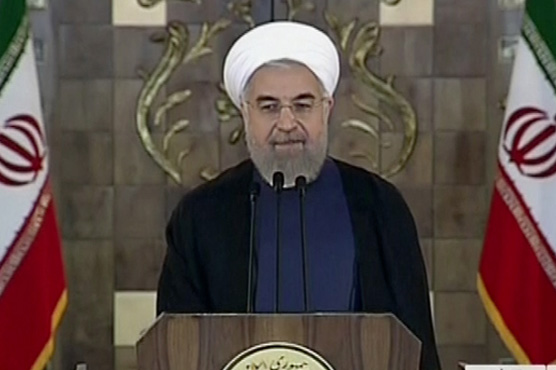
"God has accepted the nation s prayers" said of the deal in a live televised address, saying the accord would lift what he called "inhumane and tyrannical sanctions" that caused years of economic distress.
Rouhani, elected on a pledge to solve the nuclear crisis, spoke minutes after US President Barack Obama s comments on the agreement had been broadcast live on Iranian state television.
But Obama s speech was cut off when Rouhani, who has faced hardline opposition yet staked his presidency on resolving the nuclear standoff with the West, addressed the nation.
"If this deal is implemented correctly... we can gradually eliminate distrust," he said, alluding to Iran s long-strained relations with leading Western states.
"This is a mutual deal, a reciprocal deal," Rouhani said, noting that "all our objectives" had been met as sanctions would be lifted and a civilian nuclear programme acknowledged.
The pact would also "take the nuclear dossier" out of the UN Security Council s remit, reversing what he called "illegal resolutions" passed by the world body.
Although Rouhani pushed hard for the deal, the final word rested with Ayatollah Ali Khamenei, Iran s supreme leader, who set tough red lines for the talks.
Tuesday s agreement indicates those demands were met.
Iran s parliament will review the agreement and has the task of ratifying it, but top officials have said a deal with Khamenei s endorsement will not be obstructed.
The long-sought accord came after 18 days of talks in Vienna, the culmination of 22 months of diplomacy between Iran and the P5+1 group -- Britain, China, France, Russia and the United States plus Germany.
In a message posted on Twitter before the deal was formally unveiled in Vienna, Rouhani said "new horizons" could open now that "this unnecessary crisis" has been resolved.
There can now be "a focus on shared challenges", he added, alluding to Sunni Muslim extremists of the Islamic State group, who from their base in Iraq and Syria are launching attacks on both Shiite and Western targets worldwide.
Rouhani s tweet came shortly after Foreign Minister Mohammad Javad Zarif announced at talks in Vienna: "We are starting a new chapter of hope."
Since his election in 2013, Rouhani had sought to end the 13-year international standoff over Iran s controversial nuclear programme -- and with it the sanctions that have paralysed the economy.
The deal puts strict limits on Tehran s nuclear activities for at least a decade and calls for stringent UN oversight, with world powers insisting this will make any dash to an atomic bomb virtually impossible.
Iran has always denied Western suspicions that it has been trying to acquire the know-how to make nuclear weapons, and Rouhani reiterated that stance Tuesday.
"Iran will never seek a nuclear weapon, with or without the implementation" of the Vienna deal, he said, adding that to do so was against the Islamic republic s religion and such a course would contradict a fatwa from Khamenei.
Political reaction was muted in Tehran with few members of parliament immediately commenting on the deal.
However, Hossein Marashi, a former MP and member of the country s reformist movement, praised Rouhani and Khamenei s leadership on the nuclear issue.
"Experience has shown that whenever the leadership focuses on an issue we ve managed to resolve it," Marashi said.
"We managed to sit at the negotiating table with rival powers who had long enmity against Iran. If such a focus happens in domestic politics, many of our problems will be resolved."