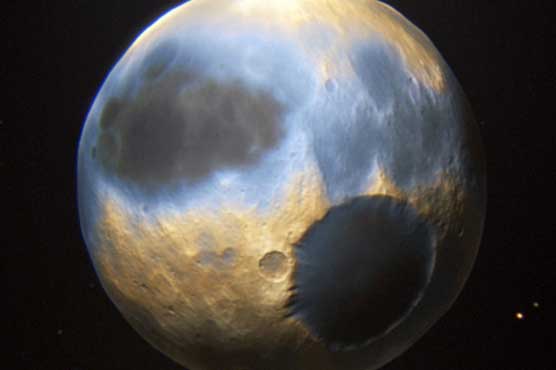
Summary Pluto has five moons, the largest of which is the size of Texas and is named Charon
WASHINGTON (AFP) - On Tuesday, a NASA spacecraft will become the first to fly past Pluto, and will send back images in unprecedented detail. Here are some of the key facts known about Pluto:
- Pluto was discovered in 1930.
- Its diameter is about 1,471 miles (2,367 kilometers), making it smaller than the Earth s moon, which has a diameter of 2,159 miles.
- Pluto has 500 times less mass than the Earth. It is a rocky body that contains ice made of methane and frozen water.
- Pluto orbits the sun once every 247.7 years.
- Pluto has five moons, the largest of which is the size of Texas and is named Charon.
- Pluto was discovered in 1930 by the American astronomer Clyde Tombaugh. It was initially considered the furthest planet in our solar system, after Neptune.
- The International Astronomical Union retracted Pluto s planet status in 2006 and reclassified it as a dwarf planet, leaving the solar system with just eight planets.
- The reason for Pluto s change in status was the small celestial body had not "cleared the neighborhood around its orbit," the IAU said. However, some planetary scientists still consider Pluto a planet.