Updated on
Summary
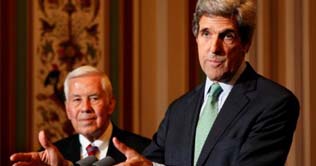
On the eve of billions of dollars of Kerry-Lugar money beginning to flow to the PPP government, Senator John Kerry, Chairman of the Senate Foreign Relations Committee, has raised several red flags, asking critical questions about accountability and almost warning that significant portions may end up in accounts of the corrupt elite. In a strong indictment of the present system in Pakistan, Senator Kerry has written a long seven-page letter to special US envoy Richard Holbrooke dated May 25, 2010 (a brief part of which was reported a few days later by the Boston Globe). Kerry says: The danger is much greater than merely the possibility of a portion of the funds being poorly spent. Kerrys letter reveals that more than 50 per cent of the KLB funds would go in 2010 directly to the Government of Pakistan or local partners. The potential for misuse is significant enough to raise warning flags about the pace of funnelling funds through institutions without a strong track record of transparent, accountable, and effective money management or significant experience in the successful delivery of projects, Kerry points out in his letter. I am writing with regard to our Pakistan assistance strategy for fiscal year 2010, which totals $1.458 billion excluding supplement 2010 funding, Kerry begins, pointing out that during the past weeks, the foreign relations committee staff had engaged in an in-depth review of how money would be spent sector wise in Pakistan. The News has obtained the full text of Kerrys letter to Holbrooke, which deals in detail with the issue under separate headlines including Leverage and Sustainability, Transparency, Accountability, Priorities, Visibility and Public Diplomacy. Under Transparency, Kerry points out that the administration should be as transparent and specific as possible about how US funds will be spent in Pakistan. To date, this process is still largely opaque to the broader public, including our Pakistani friends and partners. This lack of transparency can generate suspicion and distrust. Today, Kerry writes, the public has little access to detailed planning on how the funds will be spent. This creates confusing and unnecessary speculation in Pakistan. In a significant proposal, which may be hard to sell in Islamabad, Senator John Kerry has suggested that the Pakistani civil society should be engaged in monitoring the use of funds. The portion on Accountability raises the most critical points and expresses general fears that the money may not be spent but siphoned off by the corrupt elite. Channelling so much of the money through untested institutions so quickly could serve to confirm these suspicions, he says.