Summary Kerry said he and counterparts from Britain, France and Germany are united on seeking deal with Iran
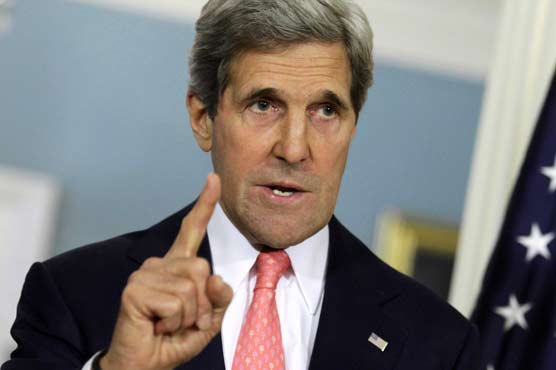
LONDON (AFP) - US Secretary of State John Kerry on Saturday said he and counterparts from Britain, France and Germany were "united" on seeking a nuclear deal with Iran, while the Iranian president said there was "nothing that cannot be resolved".
Kerry was due to hold talks in London later with British Foreign Secretary Philip Hammond, France s Laurent Fabius, Germany s Frank-Walter Steinmeier and EU foreign affairs chief Federica Mogherini, in a brief stopover amid reports of disagreements over their negotiating position.
The London gathering comes one day after the latest round of talks between Iran and the P5+1 group of world powers (Britain, China, France, Russia and the United States plus Germany) ended without a breakthrough.
However on Saturday, Washington and Tehran both indicated that major steps had been made towards a nuclear deal.
Kerry, speaking in Lausanne before heading to London, said that there had been "substantial progress", while Iran s President Hassan Rouhani declared separately that "an agreement is possible" and "there is nothing that cannot be resolved".
Kerry insisted world powers were "united" in their talks with Iran, amid rumours of a split with France, and stressed he would not rush into a bad deal.
"I emphasise: We are united in our goal, our approach, our resolve and our determination to ensure that Iran s programme is entirely peaceful," he told reporters
- Important gaps -
France has expressed scepticism over the speed of a potential deal in which Iran would place its controversial nuclear programme under severe restrictions in exchange for a stage-by-stage lifting of international sanctions.
Kerry sought to reassure that Washington was not trying to pressure partners into an agreement, saying "we have worked long and hard to achieve an agreement that resolves concerns on Iran s programme."
He said Iran still has to do more to prove that it would abide by a deal and that "important gaps remain".
"The stakes are high and the issues are complicated and all interrelated," he said.
"We recognise that fundamental decisions have to be made now, and they don t get any easier as time goes by. It s time to make hard decisions."
Iran s President Rouhani declared Saturday that although differences remained in nuclear talks with the West there was no issue that could not be resolved and that a deal could be done.
"I believe an agreement is possible. There is nothing that cannot be resolved and the other party must make its final decision for this," the official IRNA news agency quoted him as saying.
"In this round of negotiations (in Lausanne), there were differences on some issues," Rouhani said, noting that "common views emerged that can be the basis of a final agreement."
However he admitted: "Some points of disagreement persist."
On Friday, Iran and the US announced that Lausanne talks would resume on Wednesday or Thursday.
That leaves the two sides less than a week to meet a March 31 deadline for agreeing the outlines of a nuclear deal they hope will end a 12-year standoff.
- A robust agreement -
The Guardian newspaper, citing diplomats at the talks, said Washington had proposed a scheme for a phased lifting of UN sanctions against Tehran in return for Iranian action to limit its nuclear program -- but Paris only wanted a symbolic easing of the measures.
"The Americans are ready for an agreement that is far from the goals that were initially set," a source close to the negotiations told AFP.
The complex deal on the table, due to be finalised by July, is aimed at convincing the world that Iran will not build nuclear weapons under the guise of its ongoing civilian programme.
It would likely involve Iran reducing its nuclear activities, allowing tight inspections, and limiting development of new nuclear machinery.
In exchange, Iran -- which denies wanting nuclear weapons -- would get relief from the mountain of painful sanctions that have strangled its oil exports and hammered its economy.
"Iran should have access to civilian nuclear power, but not a nuclear bomb," Fabius told French television channel Europe 1 on Saturday.
"France asks that we make arrangements to allow the civilian nuclear program to develop, while preventing Tehran from obtaining the technical elements that can enable it to build an atomic bomb."
Western nations must reach a "robust" agreement that is trusted by all the countries in the region, he added.
President Barack Obama called French President Francois Hollande overnight to reaffirm their wish for a "long term comprehensive deal".