Updated on
Summary
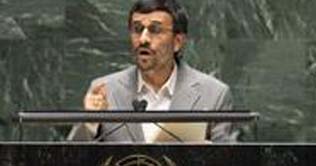
Stating that nuclear deterrence fuels a global arms race, Iranian President Mahmoud Ahmadinejad said Monday there was not a single credible proof that his country was developing nuclear weapons.In a speech at the opening of a month-long conference to review the Nuclear Nonproliferation Treaty (NPT), he described the continued possession of nuclear weapons by the United States and others as shameful.The possession of nuclear bombs is not a source of pride, Ahmadinejad told delegates from 189 countries who have signed the 1968 nuclear pact aimed at limiting nuclear weapons.Nuclear-armed Pakistan, India and Israel have not signed the treaty.Outside the UN building, where the conference is taking place, Jewish groups staged a noisy demonstration denouncing the Iranian leader and its alleged efforts to develop nuclear weapons. In a separate demonstration, Bhuddist monks called for complete destructions of nulcear weapons.The United States has threatened to use nuclear weapons against other countries, including my country, Ahmadinejad told the conference. The Zionist regime, too, continuously threatens other Middle Eastern countries.Delegates from the U.S. and its allied Western countries left the United Nations General Assembly hall as Ahmadinejad criticized the U.S. and Israel.Ahmadinejad said atomic weapons are an encouragement to other countries to develop similar arsenals and called for a timetable for elimination of nuclear arms worldwide.The sole purpose of nuclear weapons is to annihilate all human beings and destroy the environment, Ahmadinejad said. The nuclear bomb is a fire against humanity rather than weapon for defence.Its possession is disgusting and shameful, the Iranian leader said and even more shameful is the threat to use such weapons. He excoriated the United States for being the country that developed nuclear weapons - saying the U.S. brought the world to the brink of a nuclear arms race - and the only country ever to use one.Ahmadinejad criticized the imbalance in the nonproliferation treaty that allows nuclear-armed nations to maintain and even expand their stockpiles while scrutinizing other countries efforts to use nuclear energy peacefully.U.N. Secretary-General Ban Ki-moon, opening the conference Monday challenged Tehran. The onus is on Iran to clarify the doubts and concerns about its programme, the U.N. chief told the delegates.He called on the Tehran government to fully comply with Security Council resolutions demanding that it halt enrichment, which Washington and others contend is meant to produce the nuclear fuel for bombs in violation of Irans NPT obligations.We are here not simply to avoid nuclear nightmare but to build a safer world for all, Ban said. We need more examples of what can be achieved, not more excuses for why it is not possible.The presence of Ahmadinejad, the only head of state participating in the session, will test the Obama Administrations call for the world to coalesce against Irans alleged expansion of its nuclear programmes, said CBS News Foreign Affairs Analyst Pamela Falk.Diplomats are expecting a marked contrast to the atmosphere of success after Obama concluded Washington nuclear summit last month and expressed confidence that the U.N. Security Council would rally around a new round of tough sanctions against Iran. Falk said.The 189 treaty members gather every five years to discuss new approaches to problems, by agreeing, for example, that the International Atomic Energy Agency, the U.N. nuclear inspection agency, should be strengthened.At three of seven past conferences, delegates failed to produce a declaration, including in 2005, at a time when the U.S. administration, under President George W. Bush, was unenthusiastic about arms control talks.President Barack Obama has steered the U.S. back onto a negotiating track, including with a new U.S.-Russian agreement to reduce their thousands of long-range nuclear arms.Despite that, Libran Cabactulan, the Philippine ambassador who is president of this 2010 NPT conference, said he finds the No. 1 goal of many treaty nations is to press the NPT nuclear powers - also including Britain, France and China - to move more rapidly toward disarmament.In his opening remarks, the U.N. chief listed real gains for disarmament as his first benchmark for success.To that end, the Nonaligned Movement of 118 developing nations has submitted to the conference a detailed plan of action for moving towards global nuclear disarmament by 2030. One of its earliest steps is full ratification and entry into force of the 1996 treaty banning all nuclear tests.In the first concrete step associated with this 2010 meeting, Indonesia announced last week it would ratify the test-ban treaty. Obama has pledged to push for U.S. ratification of the pact, which was rejected by the Republican majority in the U.S. Senate in 1999.