Summary The organization is planning to send 1,000 monitors to Ukraine for the election.
BRUSSELS (AFP) - The European Union gave dialogue another chance in the Ukraine crisis, signing on to a new OSCE roadmap for peace Monday while warning of tough sanctions if a May 25 election fails.
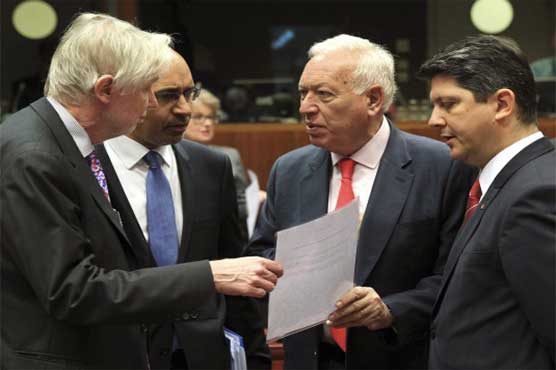
Meeting a day after sharply-criticised separatist votes in eastern Ukraine, EU foreign ministers ramped up sanctions, slapping an asset freeze and travel ban on a further 13 people.
For the first time in the months-long crisis, the ministers also targeted entities, extending the EU blacklist to 61 names by also freezing the assets of two firms confiscated in Crimea and Sevastopol after Russia s March annexation of the territory.
But the tone of Monday s statements appeared conciliatory, with the door left open to dialogue and the emphasis on the need for a successful May 25 presidential vote in Ukraine.
"I hope we will strongly support those elections," said British Foreign Secretary William Hague. "In the vast majority of Ukraine there is no difficulty with the elections going ahead."
In Brussels to brief the ministers on his talks with Russian President Vladimir Putin last week, Swiss President Didier Brkhalter, current chair of the influential East-West security organisation OSCE, said there was "a window of opportunity of a few days" ahead of the vote.
The Organisation for Security and Co-operation in Europe was planning to send 1,000 monitors to Ukraine for the election, "one of the biggest missions" in the organisation s history.
"It is very important that we believe that the election can take place and that we act in that direction," he said.
But first the OSCE was attempting to launch a national dialogue to bring all players around the table, from the government, the parliament and the regions.
Repeatedly stressing "we can t lose time", Berkhalter said he hoped not only for wide Ukrainian support but also the backing of the EU, Russia and the United States to enable roundtable talks to launch in the next few days.
"If we want to succeed in the end it is about the integration of all actors. The integration of the Russian Federation above all is very important.
"We have seen in Moscow that there is an openness for a dialogue," said Burkhalter.
In charge of the ambitious plan will be respected veteran German diplomat Wolfgang Ischinger who would moderate the hoped-for talks alongside a Ukrainian bipartisan figure.
"The most important thing right now is to get this process started in the coming days," said German Foreign Minister Frank-Walter Steinmeier. "If this can be reached I think the atmosphere in Ukraine can be turned around."
- Diplomats sceptical of Russia -
But some remained sceptical. "Mr Putin has made no concessions up until now, so why change?" said a diplomat.
"We do not see efforts by Russia to de-escalate the tension," said Lithuanian Foreign Minister Linkus Linkevicius whose country is highly suspicious of Moscow due to its history.
EU diplomats acknowledge in private that there are "very big differences" between the EU nations over widening the sanctions regime to include economic sanctions on banks or the energy sector that would also hurt many in Europe.
Hague however said at the close of the talks that Europe was intent on keeping up the pressure on Moscow and was ready to slap so-called "Phase 3" economic sanctions on Russia should it meddle in the presidential vote.
"It will be the actions of Russia on May 25 that will decide whether such sanctions are necessary," he said.
Italy along with Cyprus, Bulgaria, Spain and Greece rejected any such idea, Foreign Minister Federica Mogherini said, explaining it was not useful to set "red lines".
Meanwhile, ministers roundly condemned Sunday s separatist referendums in eastern Ukraine.
Hague said: "The votes in the Eurovision contest were more credible and carried more weight."