Summary Ukrainian soldiers and pro-Russian rebels fought fierce battles Saturday in Slavyansk.
SLAVYANSK (AFP) - Ukrainian soldiers and pro-Russian rebels fought fierce battles Saturday around a flashpoint town, with only a small reprieve to allow passage of a freed team of OSCE inspectors.
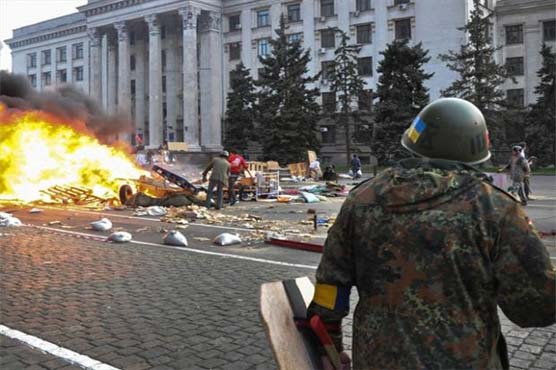
More than 50 people have died in two days of clashes nationwide -- most of them in a horrific inferno amid street clashes in the southern city of Odessa.
In the east, the military stepped up its assault on rebels in the flashpoint town of Slavyansk on Saturday.
The bloodshed was plunging the international crisis over the ex-Soviet republic into dangerous new territory.
Russia said it would now be "absurd" for the country -- whose Crimea peninsula it annexed in March -- to hold a planned May 25 presidential election.
That opened the risk of sweeping US sanctions against Russia after President Barack Obama warned of punishment if perceived Moscow meddling scuppered the poll.
US Secretary of State John Kerry underlined that threat in a call to his Russian counterpart, saying: "If those supported by Russia continue to interfere with the election, regrettably there will have to be different sanctions including the possibility or the reality of sectoral sanctions."
In his call to Foreign Minister Sergei Lavrov, Kerry called the Russian-mediated release of the OSCE observers as "a step" toward de-escalating the crisis but urged Moscow to do more and "withdraw support for the separatists."
Lavrov responded by calling on "the United States to use all of its influence to force the Kiev regime... to immediately halt military operations".
On the ground, however, there was no sign of combat subsiding.
On the outskirts of Slavyansk, the main town under attack by the army, AFP journalists witnessed a ferocious firefight between Kalashnikov-armed insurgents and soldiers outflanking their checkpoint.
At least nine people have died in clashes around the town. On Friday, the military tightened its noose on the area but lost two helicopter gunships to shoulder-launched missiles.
All of Ukraine was reeling Saturday at news of 42 deaths the day before in the southern city of Odessa, where pro-Russian and pro-Kiev militants clashed savagely and repeatedly.
Most of the deaths -- many believed to be pro-Russians -- occurred in a trade union building set alight as each side lobbed Molotov cocktails at the other.
Before Friday, the city of one million on Ukraine's Black Sea coast had been spared the unrest raging in the east.
Acting president Oleksandr Turchynov declared two days of mourning over the loss of lives across the country.
"The EU urges everyone to exercise utmost restraint and not to exploit this (Odessa) tragedy to fuel more hatred, division and senseless violence," EU foreign affairs chief Catherine Ashton said in a statement.
Ashton also called for an "independent investigation" into the fire.
Russia slammed the violence and blamed it on ultranationalists it says make up Ukraine's new Western-backed government.
The Kremlin said Russia no longer had any influence over the armed separatists, and that it had received "thousands of calls" from eastern Ukraine requesting "active help".
Russian President Vladimir Putin -- whom the West sees as masterminding Ukraine's insurgency despite his denials -- has kept an estimated 40,000 of his troops massed on Ukraine's border for the past two months. He has said he "very much hopes" he will not have to order them to invade.