Summary The evacuation has been authorised in return for release of those detained in the unrest.
KIEV (AFP) - Protesters in Kiev vacated city hall on Sunday after occupying the building for over two months as part of anti-government unrest sweeping Ukraine, in a highly symbolic gesture ahead of a new mass protest.
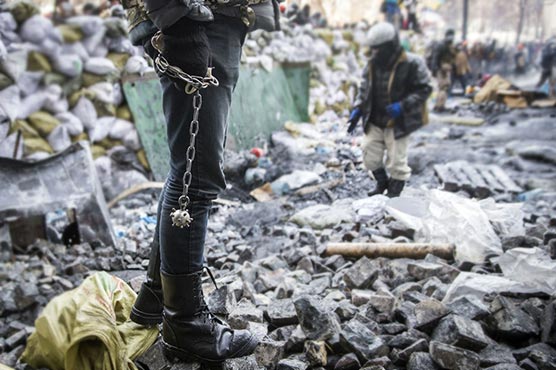
The building in Kiev s city centre had been bustling with activity day and night since it became the "headquarters of the revolution" after protesters trying to oust President Viktor Yanukovych stormed it in December, but on Sunday morning it stood eerily empty.
The evacuation was authorised in return for a last-minute concession on Friday which saw the authorities release all those detained in the unrest.
But it caused consternation among some protesters as key opposition demands such as constitutional reform and a new government still showed no sign of materialising.
"It s a bad decision... We can t trust the authorities, they re crooks. The opposition is making a big mistake," said Volodymyr Penkivski, a 56-year-old protester who had come from northern Ukraine.
"Yanukovych will take other (protesters) hostage. We can t beat a retreat. Otherwise we will all go to prison."
Ruslan Andriyko, who had been in charge of city hall, handed the building over to the authorities in a ceremony overseen by Switzerland s ambassador to Kiev, whose country holds the rotating presidency of the Organisation for Security and Cooperation in Europe, of which Ukraine is a member.
"Switzerland... was invited by both conflicting parties to participate in the process of transferring city hall to authorities," ambassador Christian Schoenenberger said as he signed an official transfer document at a table in front of the building, flanked by Ukrainian and Swiss flags.
Several hours later, a new demonstration kicked off on Kiev s central Independence Square, which is still occupied by protesters and has become a sprawling tent city barricaded off on all sides from riot police.
The protest -- attended by thousands -- is the 11th since demonstrators first rose up against Yanukovych in November when he rejected a key EU pact in favour of closer ties with former master Russia.
The president had initially ignored protesters demands, but after demonstrations turned deadly at the end of January, he dismissed his unpopular government and started negotiating with the opposition.
He also signed an amnesty law, promising to release all protesters detained since unrest began and drop charges against them in return for the evacuation of some key parts of the capital, including city hall.
The revolution continues
Last week, negotiations between the warring parties had appeared at a standstill until authorities unexpectedly announced Friday they had freed all 234 people detained in the protest movement.
The opposition has also agreed to vacate part of Grushevsky Street, where the deadly riots took place at the end of January, to allow traffic to move freely.
In an attempt to reassure protesters that the move was not a climbdown, Andriyko said guards would be posted outside city hall from now on.
"If authorities violate their commitments, we will storm city hall again and will stay forever," he said.
"The revolution continues."
The opposition still has a host of demands that have not been met, including a major reform of the constitution to reduce presidential powers in favour of the government and parliament.
And protesters are still occupying several other public buildings in Kiev, as well as Independence Square.
The 600 to 700 Ukrainians who had camped out in city hall have since moved to the October Palace, a stately concert hall that has been under occupation for several months.
Ultimately, protesters want Yanukovych himself to depart -- be it through early presidential elections or his resignation.
In a Saturday interview with weekly Dzerkalo Tyzhnia, jailed opposition icon Yulia Tymoshenko said "the only subject of negotiation with Yanukovych is the condition of his departure".
Andreas Umland, a political scientist at Kyiv-Mohyla Academy in the Ukrainian capital, said the government and opposition were thought to be negotiating a form of power-sharing agreement to be implemented before early presidential elections were held.
"For now the main question is whether Yanukovych will agree to power-sharing, what kind of power-sharing and how much power will be left to the office of the president," he said.