Summary President Abdullah Gul has intervened to try to end the latest crisis.
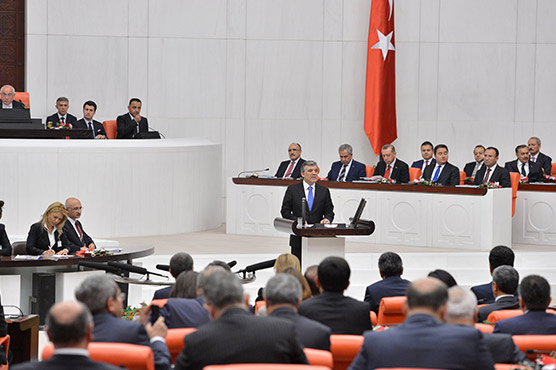
ISTANBUL (AFP) - Turkish leaders were meeting on Monday to try to ease a row over a controversial bid by the government of embattled Prime Minister Recep Tayyip Erdogan to curb the powers of the judiciary.
The proposed legislation, seen by critics as a bid to head off a widening corruption probe that has rocked the government to its core, has come under fire from the opposition and judiciary as well as Turkey s allies in the European Union and the United States.
President Abdullah Gul has intervened to try to end the latest crisis to confront the government shortly before the country goes to the polls in municipal elections in March.
He will meet Erdogan later Monday after holding separate talks on the divisive bill with the leaders of the opposition Republican People s Party (CHP), Nationalist Movement Party and the pro-Kurdish Peace and Democracy Party.
"This bill throws 90 years of democratic gains in the garbage," CHP leader Kemal Kilicdaroglu said after his meeting with Gul.
Erdogan, who has dominated the Turkish political scene for more than a decade, has seen his grip on power shaken by the graft scandal which has targeted several key allies.
Dozens of people including the sons of cabinet ministers, leading businessmen and civil servants were rounded up in a series of police raids since December.
Erdogan has responded to the probe by conducting a mass purge of the police and seeking to push through the judiciary bill that would increase government control over the appointment of judges and prosecutors.
Turkey s top judicial body, the Supreme Board of Judges and Prosecutors (HSYK), has branded the measure unconstitutional and vowed to fight it.
A debate by parliament s justice commission on the bill descended into a brawl on Saturday, with politicians throwing punches, water bottles and even an iPad.
The United States and the European Union have both voiced concern over the measure.
"(I) asked authorities to consult relevant amendments to laws before adoption to make sure they re in line with principles of EU legislation," EU Enlargement Commissioner Stefan Fuele said in a tweet on Sunday.
Erdogan, who took office in 2003 with a pledge to rid Turkey of endemic corruption, has described the probe as "judicial coup" and a "dirty" plot against his Islamic-rooted government by an erstwhile supporter.
Analysts say the episode is the result of a falling-out between Erdogan and US-based cleric Fethullah Gulen, whose movement wields considerable influence in the police and judiciary.
The escalating tensions have also exposed a rivalry between Erdogan and Gul, also a former ally, ahead of a presidential election in August.
Observers have said Erdogan is setting his sights on the presidency, currently a largely ceremonial role, hoping to change the constitution to give the president US-style executive powers.
But the judicial crisis has also highlighted the failure of parliament last year to reach agreement on a new constitution aimed at replacing a charter drawn up by post-coup military rulers in 1980.
Worst crisis since June protests
"Today s constitution is not meeting the needs arising from universal values and globalisation," Turkish Foreign Minister Ahmet Davutoglu said at a conference of ambassadors on Ankara.
"Maybe the reason for the current debates is the fact that the constitutional reform has not been carried out on time," he added.
"I hope we will have a charter based on common justice, democracy and citizenship and on which everyone is in agreement."
Several demonstrations have been held in Ankara and Istanbul since December to demand Erdogan s resignation, with police on occasion firing plastic bullets and tear gas to disperse protesters.
It is the worst crisis confronting Erdogan and his Justice and Development Party (AKP) since June, when mass anti-government street protests were staged across the country.
Gul, who is expected either to be re-elected or be the next prime minister should Erdogan become president, has so far adopted a conciliatory approach towards the corruption crisis and has repeatedly spoken out in support of judicial independence.
Commentators say the president, who is seen as closer to Gulen and his Hizmet (Service) movement, is likely to veto the judicial bill.
But since he does not want to openly position himself against Erdogan, he is holding a series of meetings with key political leaders to iron out the differences before the bill comes his way.