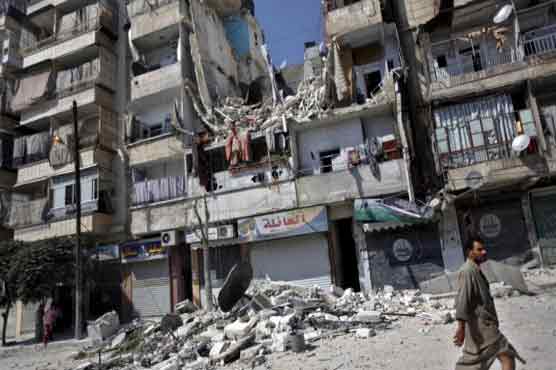
Summary The death toll from aerial bombing of an Aleppo neighbourhood Sunday has risen to 42.
BEIRUT (AFP) - The death toll from aerial bombing of an Aleppo neighbourhood Sunday has risen to 42, a monitor said, as Syria's air force targeted other areas of the city and nearby villages.
"The toll has risen to 42 people killed in Hanano," said the Syrian Observatory for Human Rights, referring to the neighbourhood hit by massively destructive TNT-packed barrel bombs.
Hundreds of people have been killed during the past week in Aleppo as Syrian aircraft have dropped crude barrel bombs on the country's onetime commercial hub, now largely reduced to rubble, according to activists, medics and other witnesses.
The Aleppo Media Centre, a network of citizen journalists in the northern city, had singled out the bombing of Hanano as especially deadly, as the barrel bombs had struck a bus, "leaving no survivors".
The Observatory's Rami Abdel Rahman said President Bashar al-Assad's regime "is trying to turn people in opposition areas against the rebels. It is killing and forcing people to flee in order to secure that goal".
Other air attacks struck the rebel-held Sakhur, Ahmadiyeh, Baideen and Ard al-Hamra neighbourhoods of the city, which has been cleaved into regime- and rebel-held enclaves since the summer of 2012.
Elsewhere in Aleppo province, Marea and Atareb villages were also hit Sunday, said the Observatory.
The Syrian Revolution General Commission, a network of grassroots activists, described "panic and mass flight to the countryside, despite the intense cold".
It also said two of the fatalities were ambulance workers, who died in the unrelenting bombardment as they tried to help wounded people.
Meanwhile, Aleppo's opposition Provincial Council announced schools in rebel-held areas would be closed "for a week... because of the systematic, deliberate bombing".
The council also said in a statement that two schools had been hit in Sunday's bombing.
Footage distributed by Shahba Press, another network of citizen journalists, showed a child in his badly damaged school saying that the bombing in Marea village happened while classes were being held.
On Saturday, Human Rights Watch said "government forces had used means and methods of warfare that... could not distinguish between civilians and combatants, making attacks indiscriminate and therefore unlawful".
It also condemned the reported use of the highly destructive barrel bombs, adding that "military commanders should not... order the use of explosive weapons with wide-area effects in populated areas".