Summary Japan Airlines (JAL) said it was submitting flight plans to China's authority about its planes.
TOKYO (AFP) - China and Japan raised the temperature in a territorial dispute Monday with each summoning the other's ambassador over Beijing's declaration of an air defence zone, a move which Tokyo called "profoundly dangerous".
The diplomatic scuffle came after Washington said it would stand by Japan in any military clash over the Senkaku Islands, which Beijing claims as the Diaoyus, and as Seoul and Taipei voiced their disquiet at China's weekend announcement.
"I am strongly concerned as it is a profoundly dangerous act that may cause unintended consequences," Japanese Prime Minister Shinzo Abe told parliament.
"Japan will ask China to restrain itself while we continue cooperating with the international community."
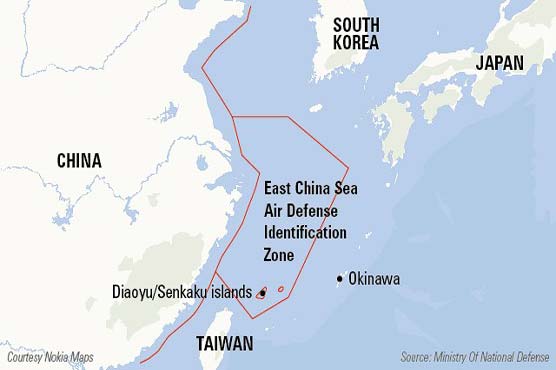
Beijing said Saturday it had established an Air Defence Identification Zone (ADIZ) that requires all aircraft flying over an area of the East China Sea to obey its orders.
The zone covers the Tokyo-controlled Senkakus, where ships and aircraft from the two countries already shadow each other in a potentially dangerous confrontation.
Japan Airlines (JAL) said it was submitting flight plans to China's authority about its planes due to pass through the zone. "We have received a NOTAM (notice to airmen) about the zone. We are submitting such flight plans as part of procedures in our daily routine," a JAL public relations official said.
All Nippon Airways is following suit, the Jiji Press news agency reported.
US Secretary of State John Kerry declared Washington is "deeply concerned", saying the move raised "risks of an incident".
"This unilateral action constitutes an attempt to change the status quo in the East China Sea," Kerry said.
Tokyo called in Beijing's ambassador to demand a roll-back of the plan which it said would "interfere with freedom of flight over the high seas", but reportedly received short shrift from Cheng Yonghua, who said Tokyo should retract its "unreasonable demand".
Cheng's opposite number in Beijing also got a carpeting in which he was told Japan should not make "irresponsible remarks" about the ADIZ.
Under the rules aircraft are expected to provide their flight plan, clearly mark their nationality, and maintain two-way radio communication allowing them to "respond in a timely and accurate manner" to identification inquiries from Chinese authorities, the defence ministry said.
The area also includes waters claimed by Taiwan and South Korea, and provoked anger in both places.
Part of the zone overlaps South Korea's own air defence zone and incorporates a disputed, submerged, South Korean-controlled rock -- known as Ieodo -- that has long been a source of diplomatic tension with Beijing.
"I'd like to say once again that we have unchanging territorial control over Ieodo," defence ministry spokesman Kim Min-Seok said Monday.
In Taipei, the government pledged to "defend its sovereignty over the archipelago" (the Senkakus).
Japan's foreign ministry said it would not respect the Chinese demarcation, which had "no validity whatsoever in Japan".
'Hypocritical and impudent'
===========================
Beijing is engaged in a series of bilateral disputes over islands and the waters surrounding them, including several separate disputes in the South China Sea.
But the most serious is with Japan over the archipelago in the East China Sea.
The disagreement has simmered for decades, but heated up in September 2012 when Tokyo nationalised three of the islands.
Japan billed the move as an attempt to avoid a much more inflammatory purchase by a vocal nationalist, but China reacted with fury and relations went into meltdown.
The two countries now play an almost permanent game of cat and mouse in the area, with official ships and aircraft shadowing each other.
Observers say this raises the risk that a miscalculation or a crash could quickly escalate into conflict, dragging in the US.
Tetsuro Kato, professor emeritus at Tokyo's Hitotsubashi University, said China's move was to be expected because thus far, no one has stopped Beijing as it tests how far it can push.
"China is trying to make Japan admit to the fact that there is a territorial dispute," he said.
"It is trying to make Japan... go back to the state before it nationalised some of the islands," he said, referring to an informal entente that was reached in the mid-1970s when the two sides agreed not to talk about the subject.
"China is seeing what Washington and Tokyo will do," said Kato.
Chinese newspapers on Monday rejected Japan's outrage.
"Tokyo is hypocritical and impudent in its complaint with Beijing," said an editorial in the Global Times newspaper, which is close to China's ruling Communist Party.
"If Japan sends warplanes to 'intercept' China's jet fighters, Beijing's armed forces will be bound to adopt defensive emergency measures," it said.