Summary Rakhmon won 83.6 percent in Wednesday's elections against five also-ran candidates
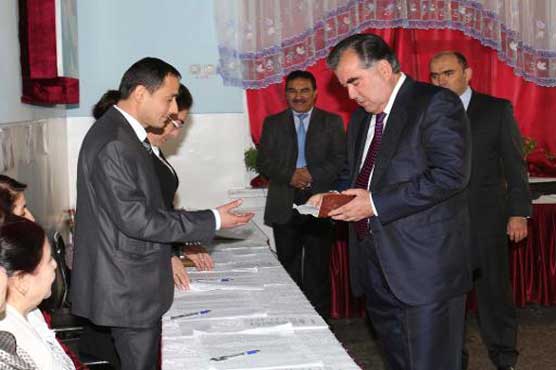
Dushanbe (AFP) — Tajikistan President Emomali Rakhmon won a crushing victory in presidential elections to secure a fourth term at the helm of the poorest state in the former Soviet Union, the election commission said Thursday.
Rakhmon won 83.6 percent in Wednesday's elections against five also-ran candidates, full results showed, an improvement even on his showing in the 2006 polls when he won 79.3 percent.
"The respected Emomali Rakhmon is re-elected president of the Republic of Tajikistan," election commission chief Shermukhammad Shokhiyon told reporters in Dushanbe. With the presidential mandate now seven years, he is due to stay in power until 2020.
Rakhmon's nearest rival, Communist Party candidate Ismoil Talbakov, won just five percent of the vote. Turnout was an equally overwhelming 86.6 percent of voters, the election commission said.
The president -- who first came to power amid the chaos of the start of Tajikistan's civil war in 1992 -- now faces the task of coming good on election promises to lift the country bordering Afghanistan out of poverty and end its dire energy shortages.
In a tale all too familiar throughout Muslim but vehemently secular ex-Soviet Central Asia, the five candidates standing against Rakhmon were virtual unknowns even inside the country, each with next to no chance of victory.
Rakhmon's most significant potential rival, female rights lawyer Oinikhol Bobonazarova of the moderate opposition Islamic Revival Party of Tajikistan, was unable to stand after narrowly failing to muster the signatures required to register her candidacy.
Bobonazarova gathered only 202,000 of the 210,000 signatures required that equates to five percent of the electorate, a shortfall her party blamed on harassment from the local authorities.
Another main opposition party, the Social Democratic Party, said it boycotted the elections because of "a lack of democracy and transparency".
The OSCE Office for Democratic Institutions and Human Rights, which is monitoring the polls, noted in its interim report that "there is no visible campaign by other candidates so far" and is due to give its final verdict later Thursday.
Shadowed by the more than 7,000-metre (23,000-feet) high peaks of the Pamir Mountains, Persian-speaking Tajikistan boasts a crucial strategic position, bordering China and Afghanistan, as well as ex-Soviet Kyrgyzstan and Uzbekistan.
Its importance could grow with the pullout of US troops next year from neighbouring Afghanistan, with whom Tajikistan shares a long and porous border.
Rakhmon, 61, who has dropped the Russian 'ov' from his name and downgraded the status of Russian in his country, has had tricky relations with Moscow. But this year he agreed to extend the presence of a Russian military base in the country until 2042.
The resource-poor country suffers from chronic energy shortages and is mired in grinding poverty that has left it the poorest ex-Soviet state and forced many to work in Russia, with their remittances providing a crucial contribution to the economy.
The government made a point throughout election day Wednesday of for once not cutting power supplies anywhere in the country as long as polling stations remained open.
Rakhmon made energy independence the key plank of his campaign, in particular ensuring the construction of his vastly ambitious pet project, the Rogun hydroelectric dam.
He also has deeply acrimonious relations with powerful Uzbek leader Islam Karimov, who has accused Tajikistan of trying to rob his country of water resources and effectively warned that the building of the Rogun dam could lead to war.
After his initial wartime appointment by the Tajik Supreme Soviet in 1992, Rakhmon enjoyed easy re-elections in 1994, 1999 and 2006.