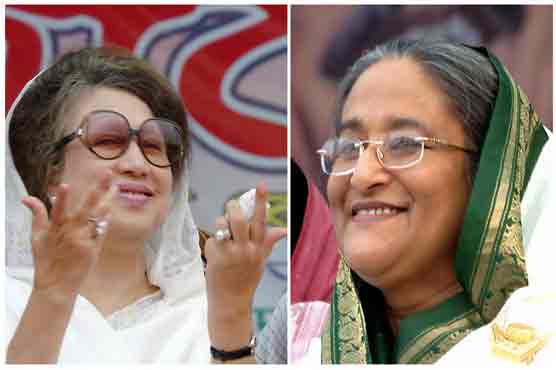
Summary Bangladesh Prime Minister invited opposition leader Khaleda to dinner as they held rare talks.
DHAKA (AFP) - Bangladesh Prime Minister Sheikh Hasina invited opposition leader Khaleda Zia to dinner as they held rare talks Saturday in a bid to defuse a mounting crisis over forthcoming parliamentary elections.
But Zia, who has demanded that Hasina quit and make way for a caretaker government to supervise the polls due in January 2014, spurned the premier s appeal to call off a three-day general strike to start Sunday.
The 40-minute phone conversation -- part of which was aired by television stations -- was believed to be the first time in at least a decade that Hasina and Zia, who has served twice as premier, have spoken, observers say.
Hasina s invitation came a day after tensions spiked as supporters of Zia s Bangladesh Nationalist Party (BNP) and its Islamist allies clashed with the ruling party and police in cities and towns across the nation, leaving at least seven people dead and hundreds injured.
"I am inviting you to the prime minister s residence on October 28," Hasina said to Zia by telephone, appealing for her rival to withdraw her strike call. That portion of the conversation was shown on television.
"The prime minister invited the leader of the opposition to a dinner at her residence. She urged her to withdraw the strike for the sake of the people. She urged her to end violence and invited her for talks," Hasina s aide Mahbubul Haque Shakil told AFP.
But Zia dismissed Hasina s request to call off the strike, the opposition leader s spokesman Maruf Kamal Khan told AFP.
"She is ready to hold talks after the end of the strike on October 29," Khan said.
There was no immediate comment from Hasina s office on Zia s decision to go ahead with the strike or whether it would affect the prime minister s dinner invitation to her rival.
Bangladesh s politics have been held hostage for two decades by bitter rivalry between Hasina and Zia, who are known as the "battling begums".
"Begum" is an honorific for Muslim women of rank in the mainly Islamic country.
On Friday, paramilitaries and police fired at thousands of rampaging opposition supporters after they hit the streets, defying a government ban on rallies.
Police said opposition supporters attacked them with small bombs, firearms and sticks, prompting them to open fire.
Zia, who addressed a huge rally of over 100,000 supporters on Friday, had branded the government "illegal" as of that day, citing a legal provision that required a neutral caretaker government to be set up three months before elections.
But Hasina s ruling Awami League abolished the provision in 2011, handing the job of overseeing polls to an overhauled Election Commission.
Hasina argues the caretaker administration system enables the army to seize power in a country which has seen at least 19 coups since 1975.
She has rejected Zia s demand for her to step down, calling it unconstitutional.
Last week, she instead floated a proposal to set up an all-party interim government which would include cabinet members from Zia s BNP, while she would remain head of the government.
The nation has a long history of political violence, but this year has been the deadliest since Bangladesh gained independence in 1971.
At least 150 people have been killed since January after a controversial court began handing down death sentences to Islamist leaders allied to Zia.
An ex-mayor of Dhaka fuelled tensions last week after he asked opposition supporters to join the protests armed with machetes and axes.
Fearing clashes, police banned all political rallies and street protests in major cities. But on Thursday night they decided to allow the BNP to hold the Friday rallies after the party vowed to defy the ban.
The last time the two main parties fought street battles was in late 2006, when dozens were killed, causing the country to shut down for weeks before the army stepped in to cancel elections and set up a military-backed caretaker government.
The BNP has vowed to boycott polls without a caretaker government, insisting the system has delivered four successive free and fair polls since 1990, when democracy was restored after over a decade of military rule.