Summary Planed reunion of people separated in Korean (50-53) war was abruptly cancelled on Sunday.
NAMYANGJU (AP) - Chang Choon didn t get much sleep as he prepared to travel to North Korea this week to see his brother and sister for the first time in more than six decades.
But the anticipation of what he called the wish of a lifetime was shattered after North Korea abruptly canceled planned reunions for families separated by the Korean War.
"My wish to meet them for the first time in 62 years has burst like a bubble," Chang, 81, said in a drawling voice by phone Sunday.
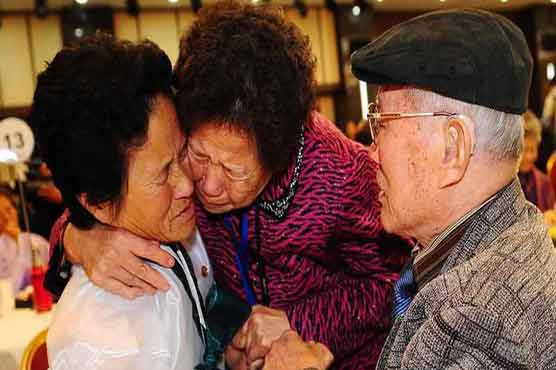
Chang is one of hundreds of South Koreans who had planned to visit North Korea s scenic Diamond Mountain to meet long-separated relatives in what would have been the first such family reunion program between the rival countries in three years.
Millions of people have been separated since the 1950-53 Korean War ended with an armistice, and not a peace treaty.
The reunions are highly emotional, as most people who apply to take part are in their 70s or older and are eager to see their loved ones before they die.
Most have had no word on whether their relatives are still alive, with their governments prohibiting ordinary citizens from exchanging letters, phone calls or email.
But the two Koreas agreed last month to resume the reunion program amid signs that their animosities were easing following springtime threats of war.
The plan fizzed Saturday when North Korea announced it would indefinitely postpone the reunions because of Seoul s "reckless and vicious confrontational racket" against Pyongyang.
A North Korean statement accused South Korea of preparing war drills against North Korea and claiming its principled, coherent North Korea policy is pushing a change in its northern neighbor.
The statement also criticized South Korea s recent arrests of leftists allegedly implicated in a pro-Pyongyang rebellion plot, calling them a "witch-hunting campaign" targeting those calling for reconciliation between the two Koreas.
The cancellation has only deepened the sorrow felt by those scheduled to attend the reunions.
"It s like being hit hard on the back of my head," Chang said, adding that he had his bags packed for the trip days before he was supposed to leave.
"I shed tears," said Moon Jeong-ah, 85, who bought long johns and other clothes for her two younger sisters who she hoped to meet for the first time since she fled North Korea with her fiance on a boat in early 1951. "I m heart-stricken when I think about my sisters."
During an interview last week at his home in Namyangju, just northeast of Seoul, Chang said he had not seen his family since he was conscripted into North Korea s army in March 1951, nine months after the war started.
He said he defected to an American-led U.N. military unit during a battle east of Seoul in August 1951.
"The battle was too fierce. American planes flew over us dropped oil drums and then incendiary bombs, and it became a sea of fire," Chang said.
Then a second lieutenant in the North s Korean People s Army, he said all his platoon members perished in the battle. "I defected to survive," he said.
Chang was first sent to a prison camp in southern South Korea. At the end of the war, he was given a choice to return home or stay in South Korea.
Chang picked the South to avoid a harsh communist system in North Korea, but didn t know the peninsula would still be divided more than six decades later.
"Sixty-two years have passed like this due to that decision," Chang said, fighting back tears. He said he would have gone home if given a second chance to decide.
Chang said he felt guilty that he was unable to take care of his two younger brothers, one of whom has died, and his sister like he said he should have as the eldest child after both of their parents died a few years before the war.
His only contact with his siblings came in 2006, when through a broker, an ethnic Korean in China, he received a letter from his youngest brother and some photos.
The face of the little boy he had last seen in 1951 had become that of a deeply wrinkled man.
"I ve wanted to see him the most as he was really like a baby, so I missed him more than others," he said.