Summary 5 people were killed Saturday as heavy clashes erupted between rival rebel factions.
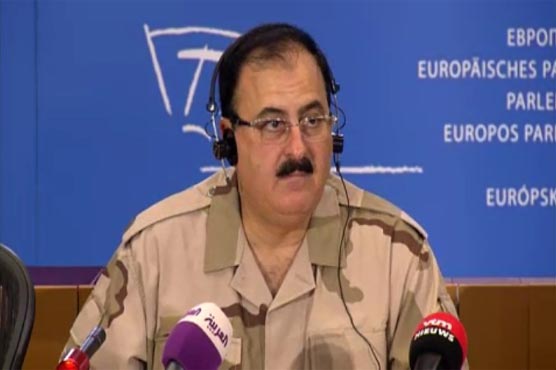
ISTANBUL / BEIRUT (AFP) - Syria s rebel Free Syrian Army chief rejected Saturday a US-Russian deal to eliminate Syria s chemical weapons by mid-2014.
"We cannot accept any part of this initiative," General Selim Idriss told reporters in Istanbul. He preceded that by saying: "We in the Free Syrian Army are unconcerned by the implementation of any part of the initiative... I and my brothers in arms will continue to fight until the regime falls."
Russia on Saturday said the UN Security Council would act if Syria breached the international convention banning chemical weapons under a deal reached with the United States to eliminate its arms stockpile.
"In the case of those demands not being fulfilled, or in the case of anyone using chemical weapons, the Security Council will take measures according to Chapter Seven of the United Nations charter," Lavrov said at a joint press conference with US Secretary of State John Kerry.
Lavrov referred to the section of the charter that provides for enforcement through sanctions, including the possible use of military force, saying that the Security Council expects Syria to comply fully with the demands of the Organisation for the Prohibition of Chemical Weapons.
Nevertheless, he cautioned that the Security Council would not accept reports of chemical weapons violations automatically but that they would be investigated.
"Of course it does not mean that each violation reported to the Security Council will be taken on trust. Each will be investigated. We will try to ensure authenticity," he said.
Meanwhile, activists say heavy clashes between Syrian opposition fighters and Islamic extremist rebel factions near the Iraqi border have killed at least five people.
The Britain-based Syrian Observatory for Human Rights monitoring group says the ongoing battles Saturday in the town of Boukamal pit the al-Qaida-affiliated Islamic State of Iraq against more moderate rebel brigades.
Infighting among rebel groups, particularly between al-Qaida-linked extremist factions and more moderate units, has escalated in recent months.
The violence undermines the opposition s primary goal of overthrowing President Bashar Assad. It also complicates efforts by the U.S. and its allies to provide greater support to the Syrian opposition.