Updated on
Summary
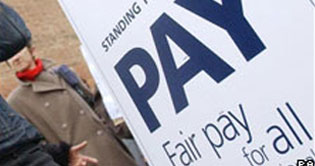
EU civil servants downed tools on Monday to protest against a proposal by EU ambassadors to cut their annual pay rise because of the economic crisis. If left unresolved the pay dispute could lead to disruptions this week when EU ministers meet for other important meetings on Agriculture, Fisheries and Transport on Wednesday and Thursday.EU council staff prepare papers, conclusions and translations for those meetings.The European Civil Service Union said 90 percent of the EU council staff had stopped working on Monday, which is an estimated 4,200 workers. Civil service staff are due to receive a 3.7 percent pay rise, in line with legally-binding agreements linking EU pay with salaries of public sector workers in a sample of eight Western European member states. However, ambassadors for most EU countries say their governments cannot justify the pay rise at a time when national budgets are being slashed. Yesterday, the Irish government announced cuts of up to 15 percent for their own highest-paid civil servants. And civil servants across the EU member states also face pay freezes or salary cuts. Extensive negotiations by diplomats in Brussels ran late into Wednesday night in a bid to find a solution which is legally sound but satisfies governments' desire to ensure that EU workers are not seen as escaping the impact of the crisis. In their pamphlets the unions point out that the 3.7 percent rise is below the 5.8 percent inflation rate for BelgiumThe ambassadors simply thought that, you know, they were sitting at a table and they said, well there is a crisis so lets strike this year's pay adjustment, which is a bit high for the economic situation, but last year we lost a lot of purchasing power and we assume that next year we will also lose a lot of purchasing power, and what counts is only the medium and long term average said the secretary general of the Union of European Public Service, Gunther Lorenz.But he says the pay rise takes 18 months to filter through and that the rules need to be applied regardless of the conditions otherwise they would need to see an increase during good economic conditions. Pay increases are calculated using an agreed formula which links EU salaries to those of officials in Belgium, France, Germany, Italy, Luxembourg, the Netherlands, Spain and the UK - some of the wealthiest and most stable members of the 27-nation bloc. The proposed increase is calculated based on civil servant salaries in eight Western European member states over the twelve-month period from July 2008 to July 2009. Public sector pay cuts introduced in recent months or planned for 2010 are not yet factored into the formula for calculating changes to pay rates. These cuts will hit EU staff pay next year. Lorenz said that if they accept a pay cut this year they will then have to suffer an additional burden next year. We do agree that there is a financial crisis and we also agree that this year's pay adjustment doesn't fit in well in this economic landscape, but we know that next year it will be the other way around and then if we complain, no body will say 'Let's not apply the method give more than what is foreseen by the method'. Then it will be automatically applied so we have to apply it in the good years and the bad years. But the problem is the time lag, as I said, it always lags up to 18 months behind the developments in member states, said Lorenz. EU civil servants work under good terms and conditions with generous benefits and job security and diplomats say they are likely to look at others ways of cutting costs. Diplomatic sources indicated it may be possible to proceed with the 3.7 percent pay rise, but to initiate a parallel move which would effectively negate the increase. This could include increasing the so-called 'crisis levy', which allows European civil servants to be taxed in exceptional circumstances. If the pay rise is effectively cancelled out by an increase in the crisis levy, it could affect the salaries of the new European Commission which takes office early next year. It could also mean the new EU executive begins its mandate amid major industrial unrest.