Summary The process has been hailed in the official press as part of a new commitment to transparency.
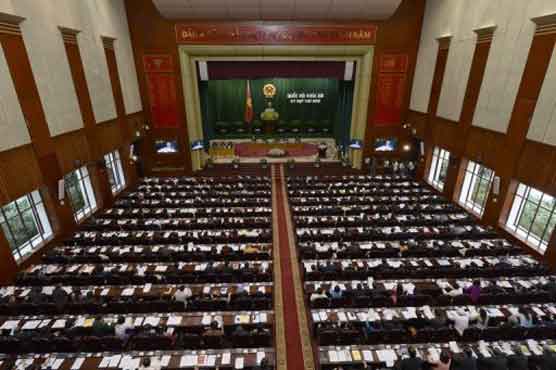
HANOI (AFP) - Vietnam s leaders faced a first-ever confidence vote in the communist-controlled parliament on Monday as the authoritarian regime seeks to allay growing public anger at corruption and a lack of political accountability.
The vote, to be held every year, was approved by the one-party state s rubber-stamp legislature last November and requires most senior politicians, including the prime minister and the president, to win support from lawmakers.
The process has been hailed in the official press as part of a new commitment to transparency and accountability. But observers saw little threat to the communist hierarchy and expected the results to be decided in advance behind closed doors.
It will not be "a proper vote", said Nguyen Minh Thuyet, an outspoken former deputy who called for a confidence vote on Prime Minister Nguyen Tan Dung in 2010.
Even so, coupled with a recent government call for public consultation over proposed constitutional amendments, the vote indicates that the party is trying to respond to rising public dissatisfaction, experts said.
"This does represent an effort by the party and state to shore up its faltering legitimacy," said Professor Jonathan London at Hong Kong s City University.
While it is highly unlikely that the vote will result in any change to the status quo, "even symbolically it is an important event, in Vietnam s evolution and in the evolution of the National Assembly in particular", he added.
The results of the voting, which covers 47 top officials who on Monday submitted reports to lawmakers of their work performance, are expected to be announced on Tuesday.
According to state media, officials who win support from fewer than half of lawmakers for two consecutive years may be forced to resign, but this is a "complicated", slow and effectively meaningless process, Thuyet said.
"Everyone will win the vote," he told AFP, describing widespread concerns that top officials would close ranks behind the scenes to support each other regardless of performance.
The most closely watched vote will be for Prime Minister Dung, who was handed a second five-year term by the party in 2011 despite his widespread unpopularity among the public.
Critics blame the 63-year-old premier s policies and governing style for Vietnam s economic malaise, endemic corruption and banking system riddled with toxic debt, mostly held by state-run enterprises.
Top officials running state-owned companies frequently flaunt lifestyles incompatible with their official remuneration, fuelling public anger at corruption, inefficiency and waste in the sprawling sector.
While the Communist Party tightly controls public debate and routinely imprisons dissidents who question the political system or call for change, Vietnamese are increasingly turning to the Internet to vent their frustrations.
Dung has been the target of much public anger and has faced down repeated threats to his premiership, including rare public criticism from senior party figures and even an unprecedented call from one lawmaker to resign.
In May the Politburo, composed of the 14 most senior regime members, once again called for disciplinary action against him, according to party sources.
But Dung survived thanks to strong support from the Central Committee, mostly from ministers, army officers, and provincial officials whom he appointed.
"It was basically an unprecedented coup d etat by the Central Committee over the Politburo," Nguyen Van Hieu, 76, a former top party member turned political commentator, told AFP.
After months of political wrangling behind the scenes, "the balance of power is clearly in favour of the prime minister", Hieu said, adding that Dung himself is now "untouchable".
With the backstage battle apparently already won, many observers suspect the vote of confidence will simply be used to seal the party s decision on this internal political dispute.