Summary Rebel coalition seized control and forced President Francois Bozize into exile.
BANGUI (AFP) - Central African Republic strongman Michel Djotodia was set to unveil a new government Tuesday after declaring he would rule by decree following the latest coup in the notoriously unstable nation.
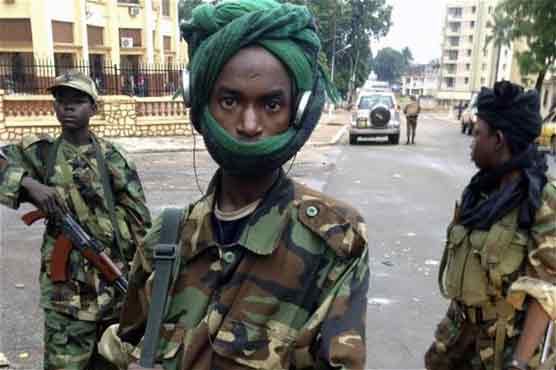
Looters were on the rampage in the capital Bangui after Djotodia s Seleka rebel coalition seized control in a rapid-fire weekend assault that forced president Francois Bozize into exile and was condemned by the international community.
The International Committee of the Red Cross said the fighting had left scores dead. Thirteen South African troops were among those killed, the nation s heaviest post-apartheid military loss.
Bangui remained tense, with hundreds of people roaming the streets on foot, many looking for food, and rebel patrols occasionally shooting bursts of gunfire into the air to disperse onlookers.
Djotodia, a former diplomat and civil servant who joined rebel forces in 2005, said he will keep Nicolas Tiangaye as prime minister in a power-sharing government after declaring Monday that he was suspending the constitution and dissolving parliament and government.
He promised elections for 2016 and did not rule out running in the polls.
The African Union suspended the landlocked former French colony on Monday, and the UN Security Council condemned the coup, threatening unspecified "further measures".
The power change followed a lightning rebel offensive that shattered a January 11 power-sharing deal between the old regime and Seleka.
Bozize, who himself seized power in a 2003 coup, fled to neighbouring Cameroon where he spent the night in the luxury Hilton hotel in the capital, according to a local official.
Members of his family have fled to neighbouring Democratic Republic of Congo and on Tuesday arrived in the capital Kinshasa, according to a government spokesman.
The Seleka rebels were initially welcomed by Bangui residents waving palm leaves in celebration, but the mood quickly darkened as looters took to the streets.
International aid agency Doctors Without Borders (Medecins Sans Frontieres, MSF) said the violence had prevented critically wounded patients from getting proper treatment and that its offices had been pillaged.
Djotodia vowed to press on with the disarmament, demobilisation and reintegration of former rebels that has been the core grievance of his Seleka movement.
South Africa, which had sent in troops at Bozize s request, said 13 of its soldiers had been killed in clashes with the rebels but President Jacob Zuma said there were no immediate plans to withdraw.
Former colonial power France, which sent in 300 troops to reinforce 250 soldiers stationed there, said its forces had shot dead two Indian nationals who approached Bangui airport in speeding vehicles Monday in a "in a particularly confusing situation".
A statement from Indian Prime Minister Manmohan Singh expressed "deep distress" over the deaths. French President Francois Hollande had written to him expressing his regret and promising an investigation, it added.
Bangui is heavily reliant on foreign aid and in an apparent attempt to reassure donors, Djotodia had vowed there would be no witch-hunt and that he would respect the terms of the January deal under which Tiangaye was named prime minister in a unity government.
The accord came after a month-long Seleka offensive that was only stopped after Chadian military intervention.
As well as suspending Bangui, the African Union announced sanctions, travel restrictions and an asset freeze on seven Seleka leaders including Djotodia.
The Central African Republic is a landlocked mineral-rich nation of 4.5 million that has been roiled by a series of coups and mutinies since independence from France in 1960.
Bozize never delivered on his promises to harness the oil, gold and uranium wealth that remains largely untapped largely because of the chronic instability, leaving the country woefully underdeveloped.