Summary Filipino had been held in village Jamla since being captured by Martyrs of Yarmouk brigade.
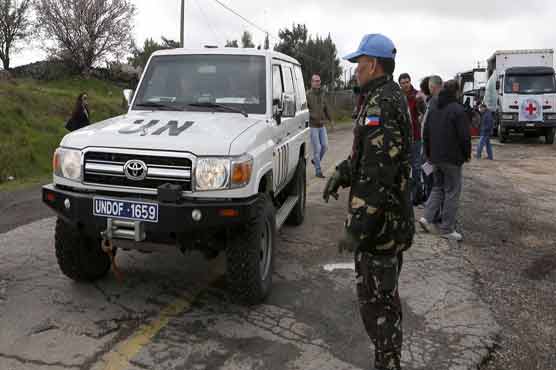
BEIRUT (Reuters) - A group of 21 UN peacekeepers captured by Syrian rebels three days ago has been taken to the border with Jordan and was being handed over to Jordanian authorities, rebel activists and a violence monitoring group said on Saturday.
"They are now being handed over in Yarmouk Valley to Jordanian authorities," rebel activist Abu Iyas Hourani said.
There was no immediate comment from the United Nations or the International Committee of the Red Cross (ICRC), which had said it would be ready to receive the peacekeepers when they left Jamla.
But Jordan s government appeared to be taken by surprise by the arrival on its northern border of the peacekeepers who had been expected to be retrieved by a U.N. convoy, which got held up in a village north of Jamla earlier on Saturday.
"So far, there is no agreement on receiving them," Jordan s Information Minister Samih al-Maaytah told Reuters in Amman. "They are not in Jordan."
The group - part of the U.N. Disengagement Observer Force (UNDOF) that has been monitoring a ceasefire line between Syria and Israel in the Golan Heights since 1974 - was seized by the Martyrs of Yarmouk rebel brigade three days ago.
They were held in Jamla, a village 1 mile from the Israeli-occupied Golan and 6 miles north of the Jordan border.
After their capture insurgents described them as "guests" and said they would be freed once President Bashar al-Assad s forces withdrew from around Jamla and stopped shelling.
A brief truce was agreed on Saturday morning to allow for the peacekeepers retrieval. Although the two-hour window of that ceasefire passed at midday (1000 GMT) before they could be extracted, the rebels said relative calm had prevailed.
A rescue effort on Friday was delayed by heavy bombardment and abandoned after nightfall, UN peacekeeping chief Herve Ladsous said.
"(Jamla) is subject to intense shelling by the Syrian armed forces," he told reporters after briefing the U.N. Security Council on the situation.
Syria s two-year civil war has spilled periodically across the Golan Heights ceasefire line and Syria s borders with Lebanon, Iraq and Turkey, threatening to engulf the region. The conflict began as peaceful protests, but turned violent when Assad ordered a crackdown on the demonstrations.
Ladsous warned that once the peacekeepers were freed, "we would strongly expect that there would not be retaliatory action by the Syrian armed forces over the village and its civilian population".
Syrian U.N. Ambassador Bashar Ja afari said the army was targeting areas outside Jamla where he said the rebels were concentrated, not the village itself. "We know for sure what we are doing and we know where the peacekeepers are," he said.
"The Syrian government forces are doing exactly what they have to do in order to bring back safely the peacekeepers, guarantee the safety and security of the inhabitants of these villages (and) get these armed group terrorists out of the area."
In several videos released on Thursday, the peacekeepers said they were being treated well by civilians and rebels.
The United Nations said the captives had been detained by about 30 rebel fighters, but Abu Issam Taseel, a Martyrs of Yarmouk activist, said the men were "guests", not hostages, and were being held for their own safety.
Under an agreement brokered by the United States in 1974, Israel and Syria are allowed a limited number of tanks and troops within 20 km of the disengagement line.
A UN report in December said both the Syrian army and rebels had entered the demilitarised area between Syrian and Israeli forces. It said that violence in the area showed the potential for escalation across the frontier, jeopardising the ceasefire between the two countries.