Summary Clashes in take place in Egypt despite state of emergency declared by President Morsi.
CAIRO: Egypt s cabinet has approved a draft law giving the army the right to arrest civilians and assist the police in providing security, a cabinet source told Reuters on Monday after the death toll in five days of anti-government protests rose to 50.
The source said the army would "behave like a police force" meaning that any detainees would go to a civilian and not military court. He did not say if the army s right to make arrests extended across Egypt or just applied to Suez Canal cities where the president has declared a state of emergency.
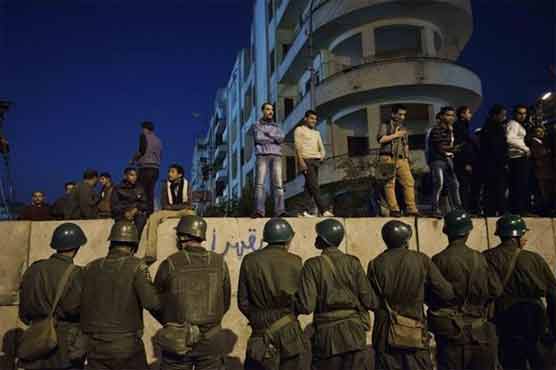
Riot police fired tear gas at rock-throwing protesters in central Cairo on Monday as clashes continued a day after Egypt s president declared a state of emergency in three provinces and vowed to deal "firmly and forcefully" with a wave of political violence roiling the country.
The violence, which began around Friday s second anniversary of the uprising that toppled longtime ruler Hosni Mubarak, has plunged Egypt once again into political turmoil and exposed the deep fault lines running through the country. More than 50 people have been killed in the unrest, which is fueled by anger over the policies of the country s new Islamist leader and the slow pace of change.
In Cairo, hundreds of young protesters fought pitched battles Monday with riot police outside two landmark Nile-side hotels and near the eastern entrance of another Cairo monument, Qasr el-Nil bridge. White clouds of tear gas hung over the area from early on Monday morning and at times whiffed across the river to the upscale island of Zamalek and the leafy district of Garden City.
Monday s violence fell on the second anniversary of the deadliest day of the 18-day uprising against Mubarak, when thousands of protesters battled police on Qasr el-Nil bridge, fighting back against water cannons, tear gas and gunshots. Police melted away later that day and have yet to fully take back the streets two years later.
President Mohammed Morsi, who has struggled to address the country s daunting social and economic problems since taking power in June, declared in a televised speech late Sunday a 30-day state of emergency in the cities of Port Said, Ismailiya and Suez and their surrounding provinces in an attempt to quell the unrest.
The military was deployed in Suez on Friday and in Port Said the next day. The two cities have been hit the hardest by the violence.
Morsi s government was taking moves to give the military an even greater role. The Cabinet on Monday approved draft legislation that would authorize the armed forces to work alongside police in keeping security, the state news agency MENA said. The military would have that role until the end of parliamentary elections, expected in April.
The legislation, which now goes to the Islamist-dominated parliament for approval, means soldiers would be maintaining law and order on the streets alongside the police at a time when many Egyptians are increasingly distrustful of both.
Anger over Morsi s latest measures was evident at the site of Monday s clashes near Tahrir square.
For the second time in as many days, thousands of Port Said residents poured out onto the streets Monday for the funeral of six of the seven people killed in violence the previous day. They offered prayers on the dead at the city s Mariam mosque and were readying to march with the bodies to the city s cemetery about a mile away. Two army helicopters hovered above the funeral. There were no reports of violence.
Rioting in Port Said over the weekend killed 44 people. The unrest was sparked by a court conviction and death sentence for 21 defendants involved in a mass soccer riot in the city s main stadium on Feb. 1, 2012 that left 74 dead.
Most of those sentenced to death were local Port Said soccer fans, deepening a sense of persecution that Port Said s residents have felt since the stadium disaster, the worst soccer violence ever in Egypt.
Stores were shuttered for the second successive day in the city and merchants were complaining that the curfew, which goes into effect Monday, would hurt their business. Already, some hotels asked guests to leave, fearing renewed violence and supplies of fresh farm produce that normally come from the Nile Delta were running low, according to the head of the local chamber of commerce, Mohammed Hassanein.
Clashes around the country Friday left another 11 dead, most of them in Suez, during rallies marking the second anniversary of the uprising that toppled Mubarak nearly two years ago. Protesters used the occasion to denounce Morsi and the Brotherhood, which emerged as the country s most dominant political force after Mubarak s ouster.
After Morsi s speech late Sunday, protesters in all three cities along the Suez Canal poured into the streets to reject both him and his state of emergency, which includes a curfew from 9 p.m. to 6 a.m. In Port Said, at least 2,000 protesters chanted against Morsi and the Brotherhood, from which he hails.
In his televised address, Morsi also warned that he would not hesitate to take more action to stem the violence.