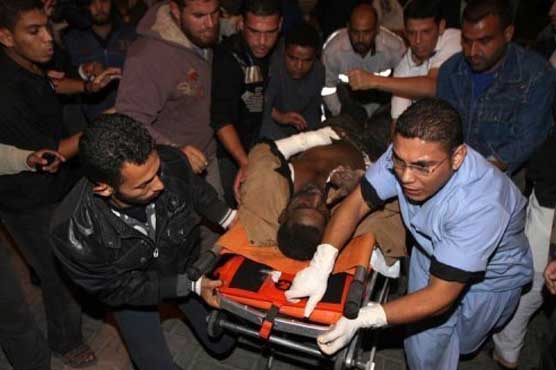
Summary Four members of a Palestinian family died in new Israeli strike on Gaza as death toll reached 109.
Israeli strikes killed 32 Palestinians on Monday, taking the Gaza death toll to 109 as UN chief Ban Ki-moon joined efforts to end the worst violence in four years and Israel s inner circle of ministers mulled their next move.
As the violence raged for a sixth day, an Israeli missile killed a senior Islamic Jihad militant in a Gaza City tower housing Palestinian and international media, the second time in as many days it has been targeted.
With Ban in Cairo pushing for a ceasefire, Hamas chief Khaled Meshaal said his movement was committed to efforts to secure a truce, but insisted that Israel must lift its six-year blockade of the Gaza Strip.
Terrified and desperate, many Gaza families have fled their homes, some seeking haven in the south which has seen fewer strikes. But they know nowhere is safe.
"My son Mohammed refuses to eat. He follows me everywhere because he s so scared and asks me every 10 minutes when we re going to die," said Umm Jihad, 37.
Mourners flocked to the funeral of nine members of one family killed in a weekend strike on a Gaza City home, the tiny bodies of the five children carried through the streets wrapped in Palestinian flags.
As the overall death toll in Gaza hit 109, with another 32 people killed on Monday making it the bloodiest day so far, the Israeli army said that 42 rockets had struck Israel and another 19 had been intercepted by the Iron Dome defence system.
To date, the military has struck more than 1,350 targets in Gaza, and 640 rockets have hit southern Israel while another 324 have been intercepted.
The violence, coming ahead of an Israeli general election on January 22, raised the spectre of a broader Israeli military campaign like its 22-day Operation Cast Lead, launched at the end of December 2008.
Analysts say the Israeli leadership appears satisfied with the success of Operation Pillar of Defence and that it could be ready for a ceasefire.
But the Jewish state has also signalled a readiness to expand the operation.
Ministers in Prime Minister Benjamin Netanyahu s inner circle -- the Forum of Nine -- were reportedly in talks over whether to agree to a ceasefire or expand the air campaign into a wider ground operation.
Israeli public radio said the meeting late Monday would touch on an Egyptian ceasefire proposal that emerged following a full day of indirect negotiations in Cairo between Israeli officials and Palestinian representatives.
The report said Israel wanted to see a 24- to 48-hour truce take effect that could then be used to negotiate the finer details of a full ceasefire.
There was no immediate indication on whether a firm decision on Egypt s proposal would emerge from Monday s meeting as it stretched past midnight and the three-hour mark.
One Israeli television channel however suggested Netanyahu was inclined to accept the plan.
All the signs point to preparations for a ground operation, with the army sealing all roads around Gaza and some 40,000 reservists reportedly massed along the border, awaiting orders from the political echelon.
Dan Harel, former deputy chief of the Israeli military, said there was a maximum of 48 hours for Egyptian-led truce efforts to bear fruit or the troops would have to go in.
"There are two basic alternatives," he told journalists in a Monday evening conference call.
"One is an agreement, cooked in Cairo, and the other is escalating the situation and moving forward into the Gaza Strip with a land effort, which is going to be bad for both sides," he said in English. "We are about 24 to 48 hours from this junction."
The latest negotiations aimed at ending the conflict, conducted behind closed doors in Cairo, ended without agreement. But all sides have expressed a willingness to engage in more talks.