Updated on
Summary Some children in Israeli prisons on stone-throwing charges are adults now.
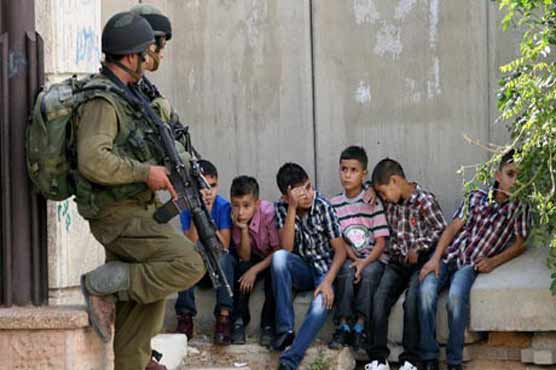
Umm Abdullah sits beneath a cross-stitched portrait of a keffiyeh-clad Palestinian youth holding a stone high in the air.Her sunny, crumbling apartment in Dheisheh refugee camp in the southern West Bank town of Bethlehem is filled with the laughter of children and grandchildren -- but two of her sons are missing.Three of her seven children spent time in Israeli prisons on stone-throwing charges when they were minors. Two of them, now adults, are still behind bars.Her youngest, 20-year-old Abdullah, has been arrested three times -- the first when he was 16.In Dheisheh, Umm Abdullahs story is often the norm.According to Defence for Children International (DCI), around 700 West Bank children are arrested every year, most accused of stoning Israeli soldiers and military vehicles.At the end of June, DCI figures showed that 221 Palestinian children were in detention. Of that number, 35 were aged between 12 and 15.Stone throwing, a symbol of Palestinian resistance to the Israeli occupation, began among the youth of Jabaliya refugee camp in the northern Gaza Strip during the first Palestinian uprising (1987-1993).And 25 years on, with those children now adults, their own children continue do the same.Under Israeli military order 1651, throwing stones is an offence which can see a child as young as 14 sentenced to 10 years behind bars if it is directed at a person with the intent to harm, or up to 20 years if thrown at a vehicle.DCI says children as young as 12 can be tried in Israeli military courts and imprisoned without charge for up to 188 days, although most are detained for between two weeks and 10 months.In a 2012 report on stone throwing, Israeli rights group BTselem found that between 2005 and 2010, the military prosecuted 835 minors on stone-throwing charges.The military declined to comment on rock-throwing within refugee camps.According to local residents and DCI, interrogations are often conducted without the supervision of a parent or lawyer, and children often go for months without seeing their families.DCI has urged the United Nations to look into reports of sexual threats and assault.