Updated on
Summary Russia and China leaders met Tuesday to foster evolving partnership to counterbalance US influence.
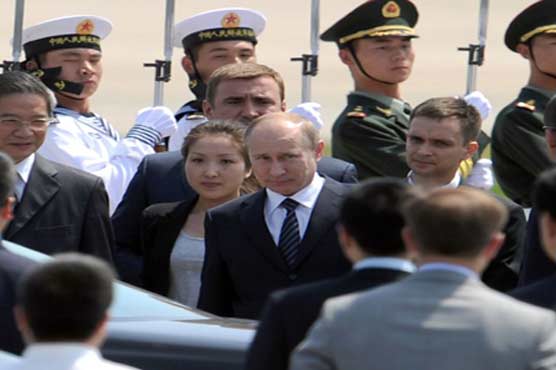
Russian President Vladimir Putins visit is his first to Beijing since resuming Russias presidency earlier this month. He talked with Chinese President Hu Jintao about the crisis in Syria as well as on Iran, bilateral trade and energy cooperation, and will join a regional summit later in the week.Russia and China advocate for an equitable international order in which all nations work to deal with the dangers before us, Putin told reporters after the talks and the signings of a series of political and trade agreements.The leaders are also expected to further their dialogue on the future of Afghanistan after U.S. forces leave by the end of 2014. Both are opposed to the long-term presence of U.S. troops in Central Asia, but theyre also wary of greater instability, including drug trafficking and regional terrorist threats, following a withdrawal.Russia and China have repeatedly defied calls by the international community to confront Syrias regime over spiraling violence. Russia has long been a close ally of President Bashar Assads regime, while Beijing opposes setting precedents that could potentially be applied to its troubled western regions of Tibet and Xinjiang.China and Russia vetoed two U.N. Security Council resolutions which raised the threat of possible sanctions against Syria and have ruled out any Libya-style military action to protect civilians in Syria. The two also voted against a resolution Friday that condemned last months massacre of more than 100 civilians in the cluster of villages known as Houla and called for an independent investigation.The U.S. has pushed Russia to join international efforts for a political transition in Syria that would see Assad driven from power.Putin, meanwhile, has sought to use Russias burgeoning ties with Beijing as a counterweight to U.S. global predominance, and the sides have found common cause in rejecting Western calls for more open politics and respect for civil liberties.Foreign Ministry spokesman Liu Weimin said China and Russia both oppose external intervention in the Syrian situation and oppose regime change by force.Both countries also oppose further sanctions against Iran over its suspected drive to develop nuclear weapons.On Wednesday and Thursday, the Putin and Hu will be among leaders attending the annual summit of the six-member Shanghai Cooperation Organization, a grouping of Russia, China and four Central Asian states seeking to boost regional integration and curb Western influence.Ties between the former Cold War rivals have warmed steadily over Putins decade-long dominance of Russian political life. Along with close coordination in international affairs, theyve sought to boost economic ties, particularly in the energy sector, aiming to raise bilateral trade to $100 billion by 2015 from $83.5 billion last year.China is Russias strategic partner. We enjoy mutually beneficial, mutually trusting, open cooperation in all fields, Putin said.Despite that, disputes and mistrust linger. Moscow is unhappy with Chinas copying of Russian fighter jets and other military hardware and the nations have wrangled for years about the price of gas to be delivered by two Siberian pipelines. Russia prefers to link gas prices to oil prices, as it does in Europe, while China wants a lower price. If Russias OAO Gazprom and China National Petroleum Corp. can reach a deal, deliveries are to start by 2015.