
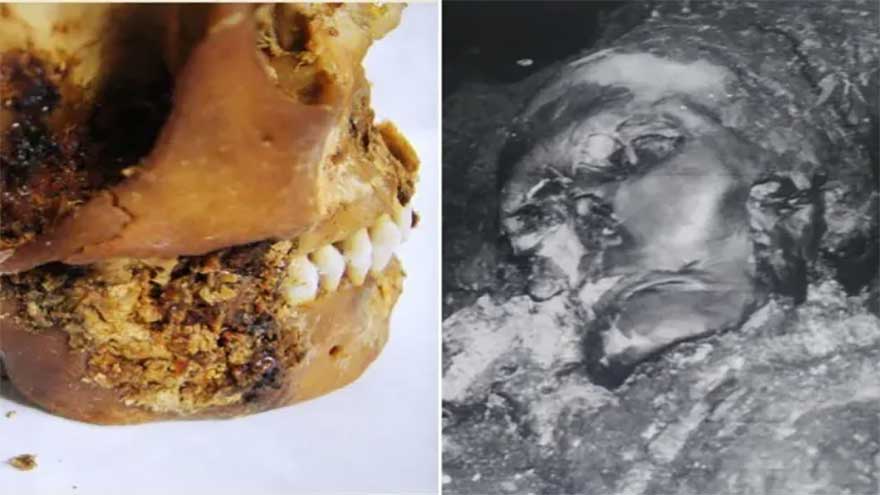
Summary It turns out humans were doing complex surgery on each other much sooner than anyone anticipated
(Web Desk) - (Web Desk) - Stunned scientists have discovered that a woman had life-saving surgery on her skull 2,500 years ago.
The partially mummified remains had signs of surgical work done to the jaw.
She even had a primitive prosthetic put in place.
And without out it, experts say she would probably have died quite soon.
The Iron Age woman was thought to be between 25 and 30 years-old when she eventually passed away – which is the average life expectancy of that time.
She was preserved by ice within a wooden coffin found in Southern Siberia.
But her skull showed signs of a major head trauma that would have seriously affected her ability to speak and eat.
Researchers from Russia‘s Novosibirsk State University don’t know exactly what caused the injury but they’ve carried out a new study to shed light on how it was treated.
The findings were tricky to obtain as scientists had to rely on CT scans to avoid destroying the permafrost-preserved mummy with any physical interference.
“It is possible that we have discovered evidence of such a surgical procedure for the first time,” said Professor Andrey Letyagin.
So what exactly did they find that was so remarkable?
The scans show two small holes that were intentionally drilled into her bone.
They also detected traces of an elastic material within them, which were most likely horsehair or animal tendon.
“This primitive prosthetic held the articular surfaces together and allowed the patient to move her jaw,” said Professof Letyagin added.
“The joint functioned, but she still couldn’t chew food on the injured side due to severe pain.”
Remarkably, parts of the woman’s skull suggest that she may have lived months or even years longer thanks to the surgery.
New bone tissue was found around the canals in her right, while those on the left were more chipped, indicating she was probably chewing more on that side.
The Pazyryk people she was part of were a small population with a low birth rate.
Experts said that, judging by the remains, her life was “valued”.