Summary The rare coins were unearthed largely on a hunch
(Web Desk) - Two rare Celtic gold coins were discovered in a Swiss bog, and they may have been left there as an offering to the gods.
While surveying a Swiss bog, two volunteer archaeologists discovered what may be two of the oldest Celtic coins ever found in the country, and they may have been offerings to ancient gods.
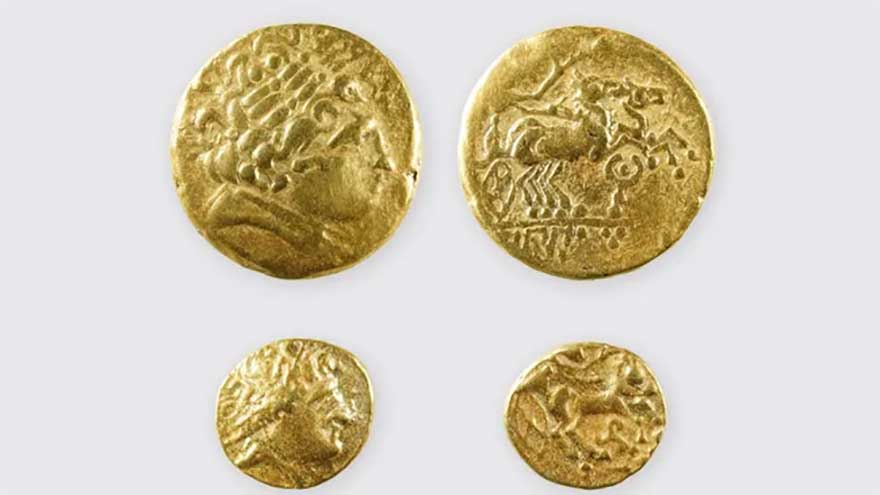
The two gold coins were minted almost 2,300 years ago, around the mid-third century B.C. "This makes them part of a very small group of just over 20 known examples of the oldest Celtic coins from Switzerland," Swiss archaeologists said in a translated statement released Dec. 18.
One coin is a stater that weighs 0.28 ounces (7.8 grams), and the other is a one-fourth stater with a weight of 0.06 ounces (1.86 grams). The term "stater" derives from ancient Greek coins. As mercenaries, the Celts of mainland Europe were increasingly given Greek coins as payment at the end of the fourth century B.C. These coins later served as inspiration for Celtic coinage at the beginning of the third century B.C., when the imitation started, as noted in the statement.
In this case, gold staters minted during the reign of Philip II of Macedon, the father of Alexander the Great, were imitated. Both coins showcase the profile of the Greek god Apollo on the "heads" side (obverse) and a two-horse chariot on the "tails" side (reverse).
However, the two newfound coins were modified slightly from their Greek originals. For example, on the smaller one's reverse, a triple spiral can be seen beneath the horses. This symbol, known as a triskele (also called a triskelion), appears frequently in Celtic art.
The rare coins were unearthed largely on a hunch. Between 2022 and 2023, volunteer archaeologists with Archaeology Baselland, the local archaeological department, discovered 34 Celtic silver coins found in the same area — the Bärenfels bog near the municipality of Arisdorf.
This prompted Wolfgang Niederberger and Daniel Mona, also volunteer archaeologists with Archaeology Baselland, to do follow-up investigations there in spring 2025, when they discovered the two gold coins, according to the statement.