Summary The island sits about 110 miles southwest of Abu Dhabi
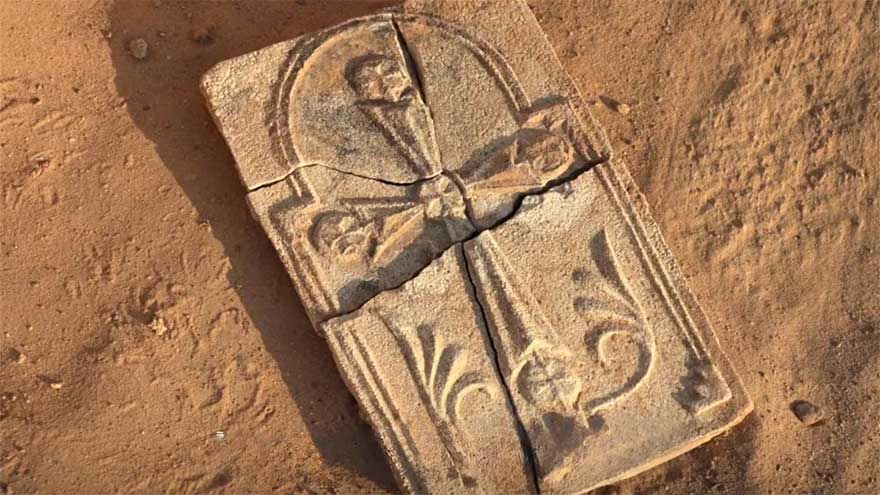
(Web Desk) - Archaeologists working on Sir Bani Yas Island have uncovered a complete plaster cross from about 1,400 years ago – a find that ties a cluster of small houses to a Christian monastic community.
The island sits about 110 miles southwest of Abu Dhabi, and the evidence connects domestic life to worship in a way that had not previously been certain.
The cross, molded in plaster and nearly 1 foot long, turned up in the courtyard of one of the houses first excavated in the early 1990s. Those houses sit near a church and monastery dated to the seventh and eighth centuries.
Lead archaeologist Maria Gajewska works with the Department of Culture and Tourism in Abu Dhabi. Her team has been returning to the site to answer questions left unresolved for three decades.
In a video report shared by regional outlets, the team explained how the plaster cross shifts the interpretation of those houses from a loose settlement to a monastic one.
They added that senior monks likely lived in seclusion nearby before joining communal prayer.
“This is a very exciting time for us, because in the past, we have always assumed that these houses were part of a dispersed monastic settlement,” said Gajewska.
“We never had concrete proof that they were inhabited by Christians. With this cross, we have now proved these houses were part of a Christian settlement.”
The cross is a molded plaque made of stucco, a form of plaster commonly used for sculpture and architectural detail.
Its size and intact condition make it especially useful for interpretation because it can be studied without heavy reconstruction.
Mohamed Khalifa Al Mubarak is the chairman of the Department of Culture and Tourism in Abu Dhabi.
“The discovery of this ancient Christian cross on Sir Bani Yas Island is a powerful testament to the UAE’s profound and enduring values of coexistence and cultural openness,” he said.
Local leaders like Al Mubarak emphasized the broader message they see in the discovery.