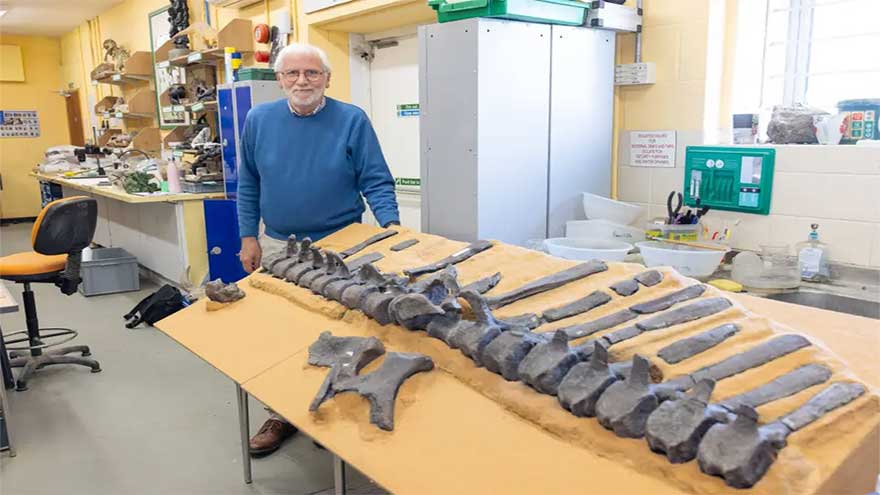
Summary They were previously thought to be from one of the two similar known local species
(Web Desk) – A new species of dinosaur has been discovered on the Isle of Wight with a distinctive feature on its back and tail that could have been used to woo partners.
Similar bone structures on other dinosaurs have long left experts stumped, with theories ranging from body heat regulation to fat storage.
But scientists believe the "eye-catching sail" on this particular type of dinosaur served as "visual signalling, possibly as part of a sexual display".
The fresh find was found among a treasure trove of 125million year-old fossils already obtained by the Natural History Museum.
They were previously thought to be from one of the two similar known local species called iguanodontian.
However, upon closer inspection scientists realised there was another.
It's been called Istiorachis macaruthurae, named after record-breaking yachtswoman Dame Ellen MacArthur, who comes from the island off the south coast of England.
Dame Ellen became famous for setting a world record for the fastest solo non-stop voyage around the world in 2005.
The first part of the dinosaur's name means “sail spine” and the second refers to Dame Ellen’s surname.
Istiorachis macaruthurae was discovered by retired GP Jeremy Lockwood, a PhD student at the University of Portsmouth and the Natural History Museum.
In his research, published in scientific journal Papers in Palaeontology, he compares the sail to modern male reptiles, who often have these attributes evolved to impress mates or intimidate rivals.
“While the skeleton wasn’t as complete as some of the others that have been found, no-one had really taken a close look at these bones before," he said.
“It was thought to be just another specimen of one of the existing species, but this one had particularly long neural spines, which was very unusual.
“We showed that Istiorachis’s spines weren’t just tall – they were more exaggerated than is usual in Iguanodon-like dinosaurs, which is exactly the kind of trait you’d expect to evolve through sexual selection."
Professor Susannah Maidment, of the Natural History Museum, added: “Jeremy’s careful study of fossils that have been in museum collections for several years has brought to life the iguandontian dinosaurs of the Isle of Wight.
“His work highlights the importance of collections like those at Dinosaur Isle, where fossil specimens are preserved in perpetuity and can be studied and revised in the light of new data and new ideas about evolution.
“Over the past five years, Jeremy has single-handedly quadrupled the known diversity of the smaller iguanodontians on the Isle of Wight, and Istiorachis demonstrates we still have much to learn about Early Cretaceous ecosystems in the UK.”