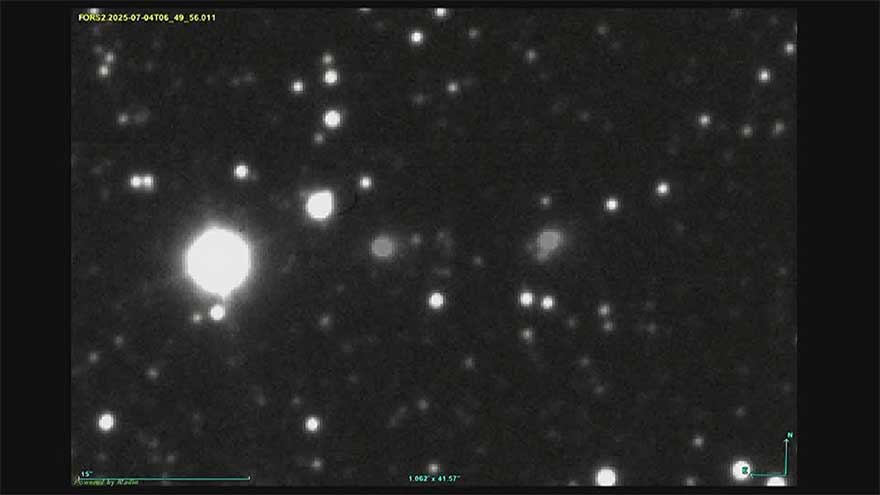
Summary The interloper, named 3I/ATLAS, was spotted on July 1 by ATLAS telescope in Rio Hurtado, Chile
CAMBRIDGE, Massachusetts (Reuters) – Astronomers are tracking a newly spotted object, likely a comet, hailing from outside the solar system, only the third time such an interstellar object has ventured into the Earth's celestial neighbourhood.
According to US space agency NASA, the interloper – named 3I/ATLAS – was first spotted on July 1st by an Asteroid Terrestrial-impact Last Alert System, or ATLAS, telescope located in Rio Hurtado, Chile.
Astronomers said its unusual trajectory indicated it had ventured from beyond our solar system, but Harvard astrophysicist Avid Loeb is making waves in academic circles by suggesting 3I/ATLAS, due to other unusual characteristics, could be an alien probe on a mission.
"The unusual trajectory of this object offers the possibility that it might have been designed so as to have some goals of a reconnaissance mission," Loeb told Reuters.
Loeb and two other researchers have authored an academic paper titled, "Is the interstellar object 3I/ATLAS alien technology?"
Journeying at a speed of around 37 miles (60 km) per second (133,000 mph) from the direction of the center of the Milky Way galaxy, 3I/ATLAS is presently located about 264 million miles (425 million kilometers) from Earth.
The only other such interstellar visitors previously observed by astronomers were objects called 1I/'Oumuamua (pronounced oh-MOO-uh-MOO-uh), detected in 2017, and 2I/Borisov, discovered in 2019.
Some other astronomers have dismissed Loeb's suggestion. "It's irresponsible science," said Karen Meech, a planetary astronomer at the University of Hawaii's Institute of Astronomy. "This is just coincidence, the path that it comes through the solar system. There's a perfectly natural explanation for this. It is behaving like a regular comet."
Loeb concedes the object may in fact be a comet, but he argues it's important for scientists not to rule out the possibility of the object being "alien tech" without additional data.
Astronomers agree the presumed comet poses no threat to Earth and will come no closer than 150 million miles (240 million km) away, equivalent to more than 1-1/2 times the distance between Earth and the sun. It will reach its closest approach to the sun around October 30, when it will be about 130 million miles (210 million km) away from our star.
The ATLAS network is a NASA-funded telescope survey built and operated by the University of Hawaii, with five telescopes around the world that scan the night sky continuously to look for objects that could threaten Earth.
Astronomers expect that the newly launched Vera C. Rubin Observatory in Chile, which houses the world's largest digital camera, will discover more objects traversing the solar system from elsewhere in the cosmos.