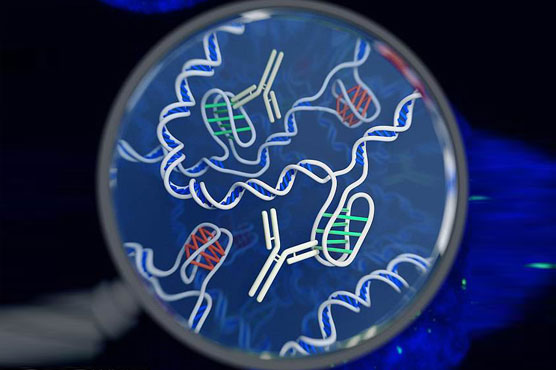
Summary Scientists have previously debated whether i-motif 'knots' would exist at all inside living things.
(Web Desk) – A new form of DNA has been discovered inside living human cells for the first time. Named i-motif, the form looks like a twisted knot of DNA rather than the well-known double helix.
According to media reports, the discovery was made by scientists from the Garvan Institute of Medical Research in Sydney.
It is unclear what the function of the i-motif is, but experts believe it could be for reading DNA sequences and converting them into useful substances.
Although researchers have seen the i-motif before, it has only been witnessed under artificial conditions in the laboratory, and not inside cells.
Scientists have previously debated whether i-motif knots would exist at all inside living things.
The iconic double helix was discovered in 1953 by James Watson and Francis Crick. It is composed of four chemical bases: adenine (A), guanine (G), cytosine (C), and thymine (T).
The structure of the double-helix comes from adenine binding with thymine and cytosine binding with guanine.
In the knot structure, C letters on the same strand of DNA bind to each other – so this is very different from a double helix, where letters on opposite strands recognise each other, and where Cs bind to Gs [guanines] , said co-author Associate Professor Marcel Dinger, Head,of the Kinghorn Centre for Clinical Genomics at Garvan.
To detect the new i-motifs inside cells, researchers developed a new tool.