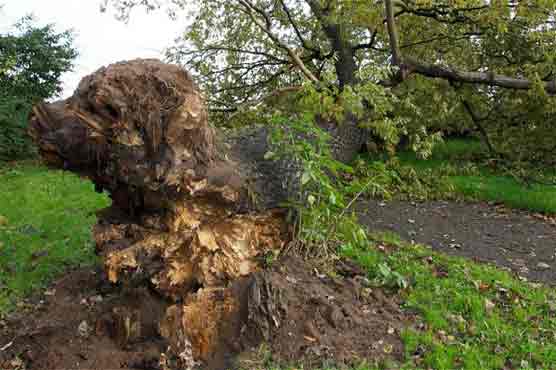
Summary St Jude's Day storm leaves behind an unlikely tree root in the shape of a dog's head.
LONDON (Web Desk) - Council workers continue to clear up damage left by Britain s worst gale in a decade.
St Jude s Day storm leaves behind an unlikely tree root in the shape of a dog s head, as council workers continue to clear up damage left by Britain s worst gale in a decade.
The dog-shaped root ball seen at the base of the felled oak tree in Alexandra Park, Ipswich, Suffolk Photo: Archant Suffolk
The sight of felled trees reveal the scene of destruction caused by the St Jude s Day storm.
But one tree, toppled as winds reached almost 100mph in parts of the country when the storm was at its height, fell and exposed its roots revealing an image of a dog.
It was knocked down in Alexandra Park in Ipswich, one of two of the town’s parks which still remain closed after being hit by the St Jude’s Day storm on October 26 and 27.
It has been suggested the root ball of the large oak looks like the head of a spaniel.
The storm wreaked havoc among many parts of the UK, leaving four people dead and hundreds of thousands of homes without power.
Storm wreaks havoc across southern UK 28 Oct 2013. Bodies of man and woman pulled out of rubble as death toll rises to four in UK storm 28 Oct 2013.
It also caused travel chaos as trains and flights were cancelled, and roads blocked by trees that had fallen or rivers that burst their banks.
Nick Clegg, the Deputy Prime Minister, also had to cancel a press conference after a crane near Downing Street fell onto the cabinet office.
The worst of the storm came in the morning rush hour in the UK on October 27, with winds reaching more than 90mph in the Isle of Wight in the early hours.
Experts estimated the storm could cost insurers between £300 and £500 million, due to “significant damage” from fallen trees. It was the worst gale to hit Britain in more than a decade, with southern and eastern England most badly affected.