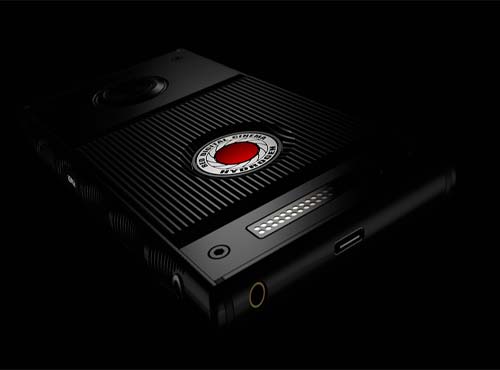
Summary RED has made the world's first smartphone
(Web Desk) - When Apple came out with the iPhone its product changed the world. The company became known internationally and Steve Jobs became a household name across the globe. However, now it seems as if another company just may take the next leap in smartphone evolution by producing the world’s first glasses-free holographic phone.
RED, the company known for making professional digital cameras for shooting Hollywood movies, claims to have produced the world’s first "holographic" phone called the Hydrogen.
According to Mashable, RED is advertising the Hydrogen as the “world’s first holographic media machine” and asserts that it doesn’t require glasses to see the supposed holograms.
The company also gave an overview of Hydrogen’s features saying that the phone has a professional holographic display which "seamlessly switches between traditional 2D content, 3D content and interactive games.”. Along with that the phone’s screen is capable of displaying “holographic RED Hydrogen 4-View content (H4V)," "stereo 3D content" and "2D/3D VR, AR (augmented reality) and MR (mixed reality)."
According to the company, the phone’s audio is another amazing feature with a special algorithm instilled in the device that can convert stereo sound into 5.1 surround sound. RED’s website says that the phone will also feature a microSD card slot, though this is not much of a feature as far as modern phones go. A teaser image of the device clearly shows a headphone jack, USB-C port, and a big camera protruding out of the backside
Other than these features the rest of the information about the Hydrogen is rather vague. There is little idea what kind of processor the phone uses, the amount of storage space it has or its type of RAM. There is also ambiguity about what kind of selfie camera the phone has or even if it has a selfie camera.
Along with that another factor to consider is the phone’s price. Pre orders of the Hydrogen show that the high end “Titanium" version of the device costs $1,595 while the lower end “Aluminum" version will go for $1,195. Such costs will ensure that the phone remains well beyond the grasp of lower income consumers.
Still if the Hydrogen proves to be a particle and reliable phone than it could become the first in the next generation of smartphones.