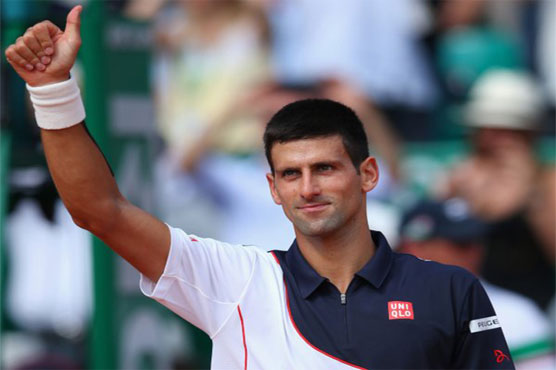
Summary Novak Djokovic supported equal prize money for men and women tennis players.
MIAMI (AFP) - Top-ranked Novak Djokovic supported equal prize money for men and women tennis players Wednesday after a firestorm of controversy over suggesting men drew bigger crowds and deserved better paydays.
"I never had an issue with equality in gender or sport or other areas of life," Djokovic said. "We all deserve more of the wealth distribution from the tournaments."
The Serbian star, an 11-time Grand Slam singles champion and top-seeded defending champion at the ATP and WTA Miami Open, apologized as he had in a statement Tuesday.
"I feel very sorry if I hurt my female colleague tennis players," Djokovic said. "I have a huge respect for all of them."
Djokovic said he had sent messages to Andy Murray, Serena Williams and others who had been critical of the comments made in the wake of his victory in Sunday s final at Indian Wells.
"I never had any intention to offend them or come up with any negative connotations in my statement," Djokovic said. "I don t make any differences between the genders. I am for equality in the sport."
After lifting the Indian Wells trophy, Djokovic said, "the stats are showing that we have much more spectators on the men s tennis matches. I think that s one of the reasons why maybe we should get awarded more."
Djokovic also mentioned the respect for women s players to compete at such a high level, noting, "they have to go through a lot of different things that we don t have to go through, you know, the hormones and different stuff."
Djokovic, who again will try to complete a career Grand Slam at the French Open, said he was shocked at the outrage his comments caused.
"I was a little bit surprised with what kind of proportions and directions this story got in the media the past few days," Djokovic said. "There were no bad intentions. People probably understood it the wrong way. The outreach of this story was tremendous."
Djokovic spent 30 minutes before talking to reporters speaking with Billie Jean King and Chris Evert about his comments, saying King was not in a fiery mood after her years fighting for gender equity in prize money.
"She was in a very good mood with me," said Djokovic. "We spoke about opportunities that a tennis player has, to use his influence to make a positive difference in the world. We had a nice and friendly chat."
King and Evert spoke to reporters earlier, generally talking beyond tennis issues about gender equity but saving a few choice words for Djokovic.
"I didn t quite understand the hormones thing," Evert said. "You don t talk about women s hormones. Anywhere."
"He was talking about our monthly situation," King said. "Like it was the dark ages."
Evert cited cultural differences between Djokovic growing up in Europe and Americans embracing equality for women as a principle in a different time frame.
"I think a lot of the comments are cultural," Evert said. "I don t hear that too much from the American men s tennis players.
"I just think America was the first country. The Europeans took the cue from America. Americans respected equality in a lot of life levels earlier than Europe did."
King noted Djokovic has had a young son recently and said that and culture could play a role in his remarks.
"My prayer is that most of the guys have daughters," King said. "I think it changes them."