Updated on
Summary The last time grandmasters clashed in Moscow during Cold war.
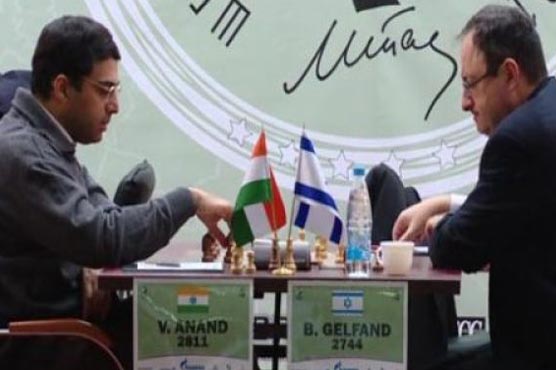
Chess world champion Viswanathan Anand of India goes up against Israels Boris Gelfand in Moscow on Friday, in the first game of their battle to decide the world title -- and $1.5 million in prize money.The last time two grandmasters clashed for the world crown in Moscow the Cold War was still raging and chess was one of its biggest psychological guns.Garry Kasparovs epic 1984-85 encounter with world champion Anatoly Karpov was controversially called off by the games ruling body as it dragged out, inconclusively.This time, the winner will be decided over a series scheduled to last three weeks. The match will consist of 12 games with a tie-break on May 30, if needed.But although he will walk away with the title of world champion, neither man is the number-one rated player.Top of the rankings is Norways 21-year-old prodigy Magnus Carlsen, a former student of the legendary Kasparov, who inspired an earlier generation of players.Moscow is nevertheless relishing the prospect of again becoming the world chess capital.It was a title it proudly held back in the era when the 64-square board was one of the battlefields pitting communism against the capitalist West in the Cold War.We had a unique situation that will never be repeated again, said 64 - Chess Review magazine editor Mark Glukhovsky.For some reason, the Soviet authorities decided to make chess one of those things like ballet in which we had to be first. It will never be that way again.The Karpov-Kasparov match had a political as well as a personal dimension.Karpov was the strait-laced darling of the Soviet nomenklatura.Kasparov, the son of an Armenian mother and a Jewish father, did not fit the Communist mould.Their gruelling battle stretched to 48 games before the powers-that-be at the World Chess Federation (FIDE) stepped in to end it before either man had won -- just as Kasparov appeared to be breaking down Karpovs will.That meant that Karpov, who had lost more than 10 kilograms (22 pounds) in the course of the draining affair, held on to his title by default.Kasparov was left to rue the politics of the game -- but he won their rematch a few months later and went on become one of the games greatest world champions.In 2005 he quit competitive chess to enter politics, becoming an outspoken critic of Russian President Vladimir Putin.The Karpov-Kasparov duels inspired a new generation of new world players, including those battling for the title today.And a 2010 study by Moscows VTsIOM pollster showed an impressive 49 percent of all Russians still play chess.It simply does not jump out the way it used to (in Russia) because many have moved their game from park benches and public squares to the Internet, Glukhovsky said.In the meantime, Western interest in the game has been piqued by the emergence of the temperamental Carlsen -- in January 2010, aged just 19, he become the youngest-ever player to top the rankings.Glukhovsky called him simply todays Michael Jordan of chess.The reason Carlsen is not challenging for the title is because he decided to pull out of the 2011 qualifying tournament, criticising the way it had been organised in a letter to FIDE.It is a decision his former mentor Kasparov criticised.That left the field clear for other contenders, and it was the Soviet-raised Israeli Gelfand who emerged from a strong field to win the 2011 Candidates Tournament and earn the right to go up against champion Anand.He is currently only ranked 20th in the world.Anand is fourth behind Carlsen, Armenias Levon Aronian and Russias Vladimir Kramnik -- and he comes to the match after an unimpressive run of form by his own high standards. Gelfand has enjoyed better form recently.Nevertheless, Moscow Chess Federation grandmaster Sergei Smagin said: Anand is the favourite. He is objectively stronger.Moscow won the right to host the first world title match since 2010 over Anands home town of Chennai after finding Kremlin-allied billionaires who were willing to splash out on the $2.55 million purse.