Summary Pakistan’s Maritime Centre of Excellence in Karachi hosts a two-day conference on emerging technologies and future warfare, highlighting innovation, maritime security and civil-military cooperation.
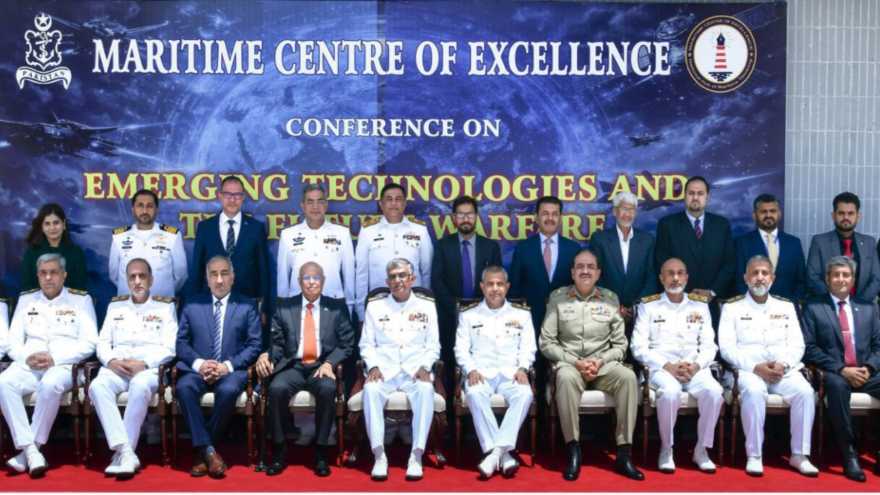
KARACHI (Dunya News) – A two-day international conference titled “Emerging Technologies and the Future Warfare” concluded on Thursday in Karachi under the auspices of the Maritime Centre of Excellence (MCE), bringing together leading voices from maritime sectors, academia, defence industries and policy circles.
The conference focused on the rapidly evolving character of warfare, shaped increasingly by advanced technologies and shifting geostrategic realities.
According to military’s media wing, the event served as a strategic platform to deliberate on how emerging technologies are redefining modern combat environments, operational doctrines and force structures. The discussions reflected a growing recognition that future security challenges will be deeply intertwined with technological advancement, requiring closer coordination between multiple sectors.

Chief of the Naval Staff Admiral Naveed Ashraf attended the closing session as Chief Guest, underscoring the importance of innovation-led defence preparedness and sustained intellectual collaboration.
Addressing the conference, Admiral Naveed Ashraf highlighted that modern warfare is undergoing a fundamental transformation driven by rapid technological evolution. He stressed that innovation, adaptability and operational relevance could only be achieved through close collaboration between the defence industry, end-users and academic institutions.
He underlined that such synergy was essential not only for strengthening Pakistan’s defence capabilities but also for advancing indigenous solutions. According to him, the integration of knowledge across these sectors would support greater self-reliance and enable the development of a cost-effective yet globally competitive defence ecosystem.
The Naval Chief further noted that Pakistan’s long-term strategic objective should include enhancing its capacity to produce home-grown solutions that also possess export potential. He emphasised that defence innovation must be aligned with real operational needs while keeping pace with international technological trends.
Focus on Indian Ocean
A significant portion of the discussions centred on the strategic importance of the Indian Ocean region, which was described as a critical theatre shaping the future of global maritime dynamics. Admiral Naveed Ashraf highlighted that the Indian Ocean plays a central role in global trade flows, energy transportation and supply chain connectivity.
He warned that any disruption in this maritime domain could have far-reaching consequences for global economies, particularly those heavily dependent on sea-based trade routes. Rising geopolitical competition and technological advancements in naval warfare were identified as key factors influencing the region’s evolving security landscape.
According to Inter Services Public Relations (ISPR), the conference also explored how maritime security challenges are increasingly linked to technological superiority, with nations investing heavily in surveillance systems, unmanned platforms, artificial intelligence and cyber capabilities to strengthen naval operations.
Civil-military integration
The proceedings further drew attention to the growing convergence between civilian and military applications of advanced technologies. Experts highlighted that this blurring of boundaries presents both opportunities and challenges for defence ecosystems, particularly in developing sustainable and innovative capabilities.
#ISPR
— Pakistan Armed Forces News (@PakistanFauj) April 23, 2026
Rawalpindi, 23 April, 2026;
A two-day international conference on “Emerging Technologies and the Future Warfare,” hosted by Maritime Centre of Excellence (MCE), culminated in Karachi, #Pakistan
Aim of the conference was to bring together maritime experts, academia and… pic.twitter.com/CS2QjVhutQ
Speakers emphasised that technologies such as artificial intelligence, autonomous systems, cyber tools and space-based assets are now shaping both civilian industries and military strategies simultaneously. This dual-use nature of technology was identified as a defining feature of modern warfare.
The conference discussions also reflected on how rapid technological innovation is transforming the nature of conflict, redefining traditional operational concepts and altering the effectiveness of force deployment. Participants noted that militaries worldwide are adapting to these changes by restructuring their doctrines and investing in next-generation capabilities.
Broad participation
The event witnessed participation from senior military leadership, government policymakers, diplomats, academics, defence industry representatives and students from multiple universities. This diverse attendance reflected the multidisciplinary nature of contemporary security challenges and the need for inclusive dialogue.
Throughout the two-day sessions, participants engaged in detailed discussions on future warfare trends, maritime security dynamics and the integration of emerging technologies into defence planning. The exchange of ideas underscored the importance of continuous intellectual engagement in addressing complex security environments.
The conference concluded with a strong reaffirmation of the need for sustained collaboration between institutions and stakeholders. It highlighted that navigating the future of warfare will require long-term intellectual synergy, continuous research and adaptive strategies capable of responding to fast-changing technological landscapes.