Summary Panel discussion at Indus Conclave 2025 spotlights Pakistan’s governance, education and population challenges with calls for devolution and local government reforms.
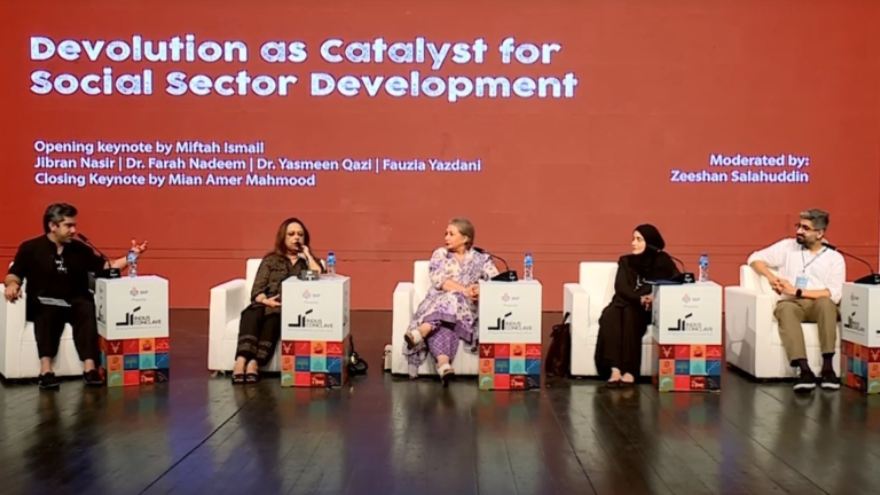
LAHORE (Dunya News) – The Indus Conclave 2025, organised by the Punjab Group at Lahore's Alhamra, brought together leading voices to debate the theme “Devolution as Catalyst for Social Sector Development” on Saturday.
The session featured development specialist Dr Farah Nadeem, public health expert Dr Yasmeen Qazi, and governance specialist Fauzia Yazdani, moderated by Zeeshan Salahuddin.
The discussion zeroed in on Pakistan’s governance structure, its social sector gaps, and the urgent need for decentralisation. Panellists argued that education, healthcare and population issues remain unresolved largely due to ineffective governance and a lack of empowered local institutions.
CALL FOR LOCAL GOVERNMENT
Fauzia Yazdani traced how decentralisation has faltered since the 18th Amendment of 2010, which she said was driven by political considerations rather than genuine social sector reform. “We don’t need more provinces, we need an effective local government,” she stressed, recalling how local councils under Musharraf’s era had revenue collection models and accountability mechanisms that were later dismantled.
She argued that devolved institutions, if empowered, could restore accountability and responsiveness. “Accountability is a very positive indicator,” she said, noting that citizens can directly engage with councillors in ways they cannot with national legislators.
Her remarks highlighted how communities often expect MPs and MNAs to perform tasks, such as local sanitation, that are not part of their mandate. Strengthening councils, she said, would align governance with its actual responsibilities.
POPULATION AND INEQUALITY
Yazdani also linked Pakistan’s governance crisis to its rapidly growing population, calling it the root cause of multiple failures. She noted that according to the 2023 digital census, “your woman is giving birth to six children,” while 24 percent of women cannot make their own healthcare decisions. She further cited that 38 percent of women experience violence and 42 percent believe spousal abuse is permissible.
She described population planning as a “brown envelope” issue – taboo and deliberately concealed. “Till now, you don’t use the word population control,” she observed, arguing that education and healthcare targets cannot be achieved without tackling the issue directly.
Dr Yasmeen Qazi reinforced this view, saying that public silence around family planning continues to obstruct meaningful development. Panellists warned that ignoring population pressures risks deepening inequities between provinces and districts.
FUTURE OF GOVERNANCE
Other speakers, including Dr Farah Nadeem, stressed the importance of resource distribution, institutional reforms, and social inclusion. The debate expanded to the mismatch between education and employment, echoing UNDP’s 2015 report which warned that within a decade Pakistan would face “people with degrees, but no jobs.”
Concerns were also raised over digital culture shaping both opportunities and risks. “We all want a quick fix solution… TikTok is fine, WhatsApp message is fine. We don’t want to read books,” one panellist remarked, pointing out how shortcuts undermine deeper reform and learning.
Speakers further highlighted persistent inequality, with women underrepresented in governance and public discourse often reduced to commentary on appearances rather than substance. They argued that meaningful change requires institutionalisation of local government, greater accountability, and a national willingness to confront difficult issues.