Summary Stresses new provinces should be formed to ensure fair distribution of resources
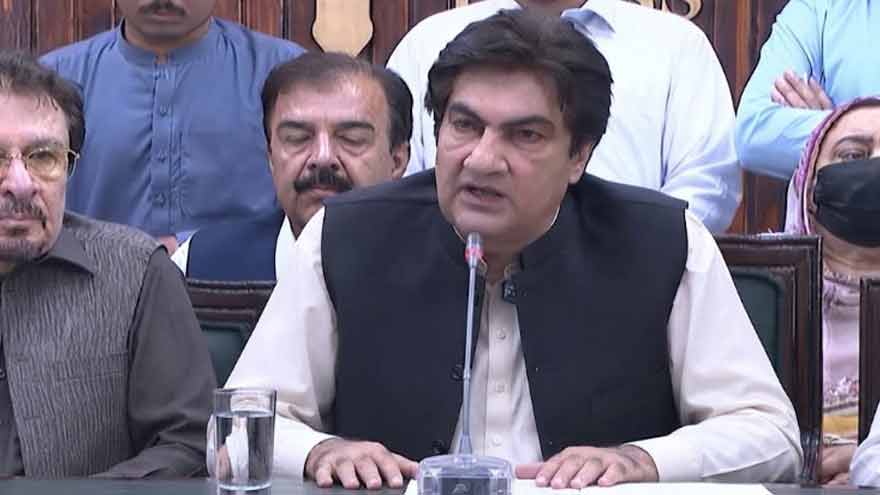
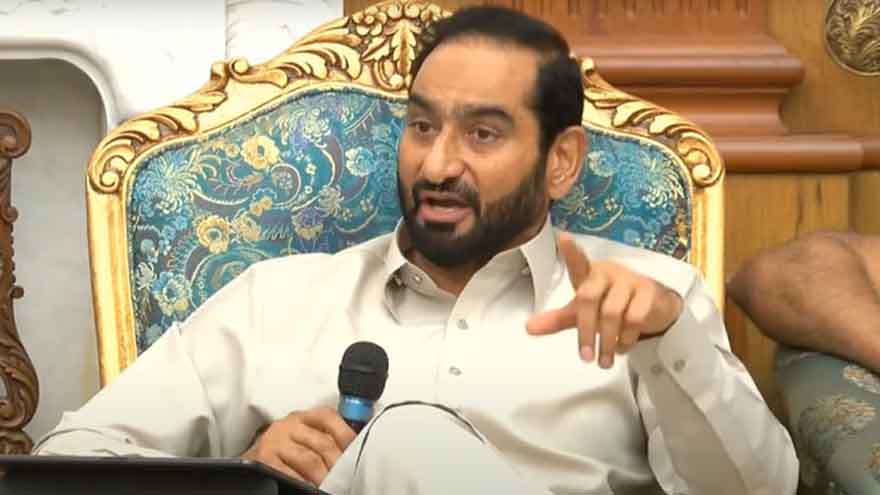
ISLAMABAD (Dunya News) – Punjab Group Chairman Mian Amer Mahmood on Tuesday held an interactive session with senior journalists in Islamabad, where he underscored the need for making new provinces in Pakistan.
The Punjab Group chairman started his talk by stressing that the new provinces should be formed to ensure fair distribution of resources, equal rights, and effective governance, warning that mismanagement and unequal access to resources hinder national progress.
Around the world, smaller provinces have contributed to development, he said, while in Pakistan, after the 18th Amendment, powers and funds were transferred to the provinces. However, despite having resources, facilities are not reaching the grassroots level.
He noted that sectors like education and health in Pakistan are in a state of decline. Pakistan ranks 140th out of 170 on the Public Welfare Index, and 168th out of 193 on the Human Development Index.
Mian Amer Mahmood advocates new provinces for fair resource allocation
The chairman of Punjab Group stated that people in Pakistan are dying of hunger not only during floods but otherwise as well. He pointed out that child growth stands at only 44 percent, which shows that the nation’s future has already been compromised for the next 20 years.
He further highlighted that 25 million children are out of school, the highest number in the world, adding that despite having a larger population, India has fewer out-of-school children compared to Pakistan.
Mahmood criticised the lack of balanced development, saying that except for the capital city, no other region has been properly developed. “We have only built five major cities. We are not blaming individuals, but the system itself. Surely, good people must have come in 78 years, but real development has not taken place in the country,” he said.
Power sharing is not in our genes
Mahmood said that the country lacks the rule of law, and since justice is not delivered, criminals never face punishment. “Perhaps power-sharing is not in our genes. If every division is made a province, we would have 33 provinces, and solving problems would become much easier,” he stated.
Mahmood explained that when people say Punjab or Sindh would not agree, they forget that Punjab is not just a set of four walls but home to 130 million people. He added that in the past 78 years, local governments were formed and dissolved repeatedly, yet no experiment succeeded.
Every party is controlled by a single family
He remarked that Pakistan suffers from a leadership vacuum because leaders do not emerge from within the system. “Every party is controlled by one family. We say make 33 provinces, and leadership will emerge from the people themselves. We don’t have organic leadership,” he said.
The Punjab Group chairman added that even if a small government is formed, people will still come forward to govern. “Maybe the people are not that bad—it is the system that doesn’t exist for them to work in. Even if prime ministers and chief ministers work day and night, an audit after one year would reveal many flaws,” he noted.
In 80 years, some leader should have worked on this
Mahmood emphasised that no country in the world has provinces as large as Pakistan’s. “India once had 9 provinces; today it has 37. There is constant competition among Indian states. In Pakistan, our provinces don’t even generate proper GDP. In these 80 years, at least some leader should have worked on this,” he said.
He clarified that the discussion is not with politicians but with the people. “In India, every five years, through constitutional amendments, one or two new provinces are created. We too can amend our Constitution in this way. We may not have the authority to govern, but we do have the right to raise awareness among the public. Political parties cannot stay detached from the people—we say such a demand should come from the public itself,” he concluded.
No one wants South Punjab Province
Mahmood said that there is no genuine demand for a single “South Punjab” province. “Bahawalpur, Multan, and DG Khan each want to be separate provinces; there is no united demand for South Punjab. Creating new provinces will actually reduce expenses,” he stated.
He explained that ten seminars have already been held and extensive research on Punjab has been conducted. “I don’t want to single out Punjab only. There is a huge difference between the expenses of the chief ministers of Balochistan and Punjab. The level of authority they enjoy determines their budget and protocol,” he said.
Smaller provinces mean smaller budgets
According to him, when provinces are smaller, budgets shrink as well. “Protocol and expenditures won’t remain based on a population of 130 million but will decrease. Many departments have been created and then shut down, yet their budgets are still being consumed. Punjab’s development budget runs into billions of rupees,” he noted.
Mahmood highlighted inefficiency in funds utilization, saying: “The issue is not lack of money, it’s that so much money cannot even be spent. Take the Punjab Women Protection Authority—it has a budget of Rs. 180 million, yet only Rs. 1.4 million was actually spent on public service. Hundreds of employees are hired there, and Rs. 170 million is going only to salaries.”
He further pointed out that wheat production fell by 2% last year despite large allocations. “We even have departments for seed research and new flower varieties. The Floriculture Department receives Rs. 270 million annually with 350 employees, but it hasn’t introduced a single new flower—PHA is just buying flowers from the market,” he said.
He added that Punjab also has a Road Safety Authority tasked with enforcement, along with many such redundant departments. “There is even a Directorate of Katchi Abadis, employing 300–400 people. If we try to create 20 or 22 new boundaries, opposition will block them,” he argued.
Divisions already provide natural boundaries
He proposed a practical solution: “We say, make every division a province. Divisions already have clear boundaries. Each division has a commissioner and an RPO. Just make the commissioner the chief secretary and the RPO the IG. In such a large system, things are bound to be mismanaged. Only by making the system smaller can it be managed effectively,” he concluded.
Creating divisional units will be beneficial
He said that in the past, Peshawar was part of Punjab, Multan was a separate province, and Lahore was its own province, while Khyber Pakhtunkhwa didn’t even exist as a province. “We are not doing politics. If chambers are taken down to the divisional level and a unit (shak) is created in every division, it will benefit all of us,” he noted.
He pointed out that in the last 80 years, Pakistan has built only five capital cities. “In all these decades, we haven’t built a sixth city. Faisalabad, our third-largest city, still lacks a proper hospital, school, or college. It looks more like an expanded village than a developed urban center,” he said.
No real local govt in 80 years
Mahmood stressed that Lahore’s population has kept rising because of heavy migration. “No matter how much money we gave Lahore, migration always outpaced it. For 80 years, we never established a proper local government. When nazims existed, Pakistan had strong ties with the world, and many international visitors came here,” he said.
He recalled a personal experience during a U.S. government shutdown when he needed a visa but the embassy was closed until the budget was passed. “Their government, even with a majority, faces systemic challenges. Ours doesn’t even have such systems,” he remarked.
He added that Pakistan has 106 major districts, while India, with its 37 states, has seen newspaper readership grow. “India is expanding its provinces every election cycle, while we have been stagnant. They started with nine provinces and now have 37. We, on the other hand, have failed to adapt, and in every global survey, Pakistan ranks among the bottom ten,” he stressed.
Provinces are failing to deliver
He noted that movements for new provinces already exist: in Balochistan, in Hyderabad and Khairpur, in Hazara (Khyber Pakhtunkhwa), and in Potohar. “This system has failed us for 80 years. New provinces will strengthen democracy. With 33 provinces, we would have 33 assemblies and 33 chief ministers, creating space for leadership to rise from the grassroots,” he said.
Mahmood emphasised that existing divisional headquarters already have the infrastructure for secretariats. “When new provinces are made, their commissioners will no longer be the bosses—an elected political leader will be. New provinces will allow leadership to rise by proving their worth through work,” he explained.
We need to shape public opinion
He said the right way forward is to build public consensus. “Our political parties have never prioritized this. Across the country, there is no proper education, no quality healthcare, no law and order, and no modern infrastructure. Provinces have failed to deliver basic services. Even a murder case takes 16 to 18 years to conclude,” he added.
According to him, the only way forward is to restructure the system through new provinces so that governance becomes manageable and people actually receive the facilities they are entitled to.