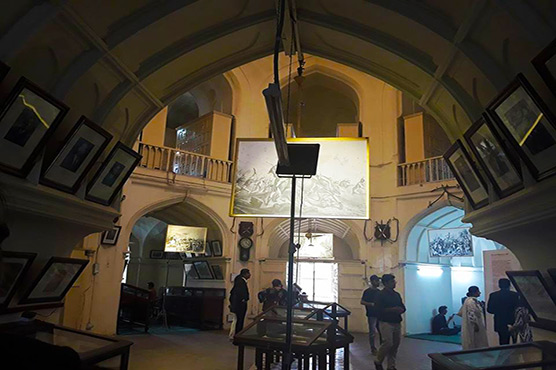
Summary The exhibition presented selections from the archives on the events of 1857. Photo: Aroosa Shaukat
Punjab Archives in collaboration with the Punjab Information Technology Board opened its doors to the public to give a glimpse of “The Great Rebellion” – one of the preserved archival works dating back to the mid-18th century.
Exhibited at the magnificent Tomb of Anarkali, the exhibition presented selections from the archives on the events of 1857, when South Asia’s nationalists conducted a last major attempt to rid themselves of the exploitative rule of the British East India Company.
‘Fear and Vengeance in 1857’ is a selection from the archives of the Great Rebellion with descriptive events of 1857 giving the British side of the story. The Punjab Archives houses a portion of these documents from May 1857 to April 1858 until the Parliament of the United Kingdom liquidated the British East India Company’s Raj over India and transferred it to the British Crown rule in 1858.
.jpg)
Letters on display on the censorship information about the mutiny during the "Great Rebellion". Photo: Aroosa Shaukat
The letters exhibited for the public, which is not available anywhere else in the world, is part of the Special Collections of the Punjab Archives in Lahore, including British Army wartime telegrams, urgent circulars and letters addressed primarily to Chief Commissioner, Sir John Lawrence.
Speaking to Dunyanews.tv, curator Sadaf Chughtai explained various dimensions of the exhibition that took a team of experts to display a unique storyboard depicting various features of the war from letters, to telegrams and eight visuals of the various important part of the war.
The idea came up when historian, Dr. Yaqoob Khan Bangash, who is also the project director, suggested on exploring the prospect of exhibiting detailed documented archives and repository on the mutiny of “The Great Rebellion”.
“We had visual materials of the war, and we tried finding letters and pairing it with the events depicted on them. The visuals had captions on them which led us to find the exact narrative/letter/document through research,” explained Chughtai on the process of finding the archived document for the visuals.
.jpg)
Visuals of "Fear and Vengeance in 1857" displayed at Anarkali’s tomb. Photo: Aroosa Shaukat
Furthermore, to find the right document for the visuals the researchers looked for key words in the archives.
“For the first exhibition, we wanted to use the drama already in these engravings, which are definitely from a British point of view of how they feared, and their version of showing Sepoys as very muscular, savages,” said Chughtai.
Another important element of the exhibition was to display how the Company circulated letters to the editors of that time, to censor the reports of rumours regarding the rebellion. With warnings of confinements and punishments to those who will write on the mutiny.
Chughtai added there is also a letter they found for one of the visuals, informing all the chief commissioners about an act that allowed them to hang people on spot without any trials.
The researchers also found some correspondence that explained how Sepoys were becoming ‘more bold’ and on the rumours that they were attacking baggage wagons.
All of these are part of the storyboard where visitors can read about the visuals and the events, weaving into a narrative.
“This is the first volume and hopefully more will come,” Chughtai said.
The next in line for these researchers is to look into the archive on the “Siege of Delhi” and trial of Bahadur Shah Zafar.
Exhibition Fear and Vengeance in 1857 will be displayed until June 8.