Summary Sopore born Ahzal was a Part-1 medical student when he joined Jammu Kashmir Liberation Front.
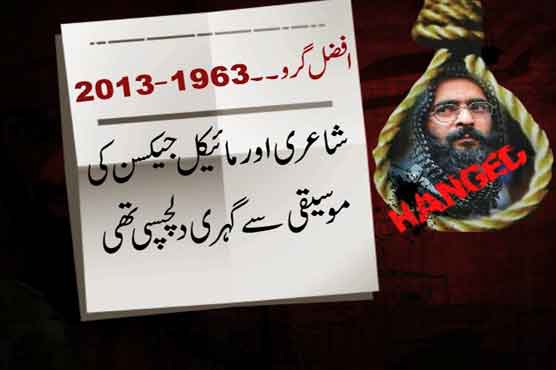
SRINAGAR: Muhammad Afzal Guru, hanged on Feb 9, was declared guilty of conspiracy in the December 2001 attack on the Indian Parliament and was sentenced to death by Special POTA Court in 2002.
Delhi High Court had confirmed the judgment in 2003 and his appeal to the same was rejected by Supreme Court of India in 2005.
The sentence was scheduled to be carried out on 20 October 2006, but Afzal was given a stay of execution and remained on death row. On 3 February 2013, his mercy petition was rejected by the President of India Pranab Mukherjee. He was hanged at Delhi s Tihar Jail around 08:00 A.M. on February 9, 2013.
Guru was born in Aabgah village near Sopore town in Baramulla district of Jammu and Kashmir. He passed the Matriculation exam in 1986 and completed his higher secondary education in Sopore.
He subsequently got enrolled in medical college. He had completed the first year of his MBBS course and was preparing for competitive exams.
However, he became a member of Jammu Kashmir Liberation Front where he received training.
Curfew imposed in Kashmir valley, NH closed to avert trouble - Times of India Last Retrieved 9 February 2013. Unhappy with the situation there, he moved back to Kashmir and surrendered to the Border Security Force.
His native place is Sopore and he was doing a commission agency business. It was during this business venture that he came into contact with Tariq of Anantnag, who motivated him to join Jihad for liberation of Kashmir and assured him of financial assistance.
He crossed the Line of Control and proceeded to Muzaffarabad in [[Azad Kashmir|. After learning how to handle arms and ammunition, he returned to Sopore and led a group of nearly 300 militants.
On a visit to Kashmir in 1998, he married a Baramulla native Tabassum. He took up a job with a pharmaceuticals firm and served as its area manager. Simultaneously, he ran a commission agency. During this period, he used to shuttle between Srinagar and Delhi.
It was his business that led to a meeting with one Tariq. This resident of Anantnag convinced Afzal to aid some Pakistan-trained terrorists in their deadly mission.
Tariq introduced him to other terrorists from Ghaziabad, Pakistan who were proclaimed offenders in Kashmir who further exhorted him to join the terrorist movement and apprised him of the mission to carry out attacks on important institutions in India like Parliament and Embassies and asked him to find a safe hideout for the terrorists in Delhi.[10] He has himself confirmed these in an in his own interviews with various newspapers.
The attack was conducted jointly by the Lashkar-e-Toiba (LET) and the Jaish-e-Mohammad (JEM). Seven members of the security forces, including a female constable, were killed, as were the five still incompletely identified men who carried out the attack.
Following were the charges against Afzal Guru:
Recovery of explosives from his place of hideout in Delhi.
Conspiring to commit and knowingly facilitated the commission of a terrorist act or acts preparatory to terrorist act and also voluntarily harboured and concealed the deceased terrorists knowing that such persons were terrorists and were the members of the Jaish-e-Mohammad, a banned terrorist organisation, which is involved in acts of terrorism and hence committed an offence punishable Under Section 3(3) (4) and (5) of Prevention of Terrorist Activities Act.
Possession of 10 Lakhs given to him by the terrorists who were killed by the police when they had attacked the Parliament of India.
He was arrested along with Shaukat and later on explosives were found from their hideout in Delhi. Eighty witnesses were examined for the prosecution and ten were examined for defense. The judgment mentions:
"The incident, which resulted in heavy casualties, has shaken the entire nation and the collective conscience of the society will be satisfied if the capital punishment is awarded to the offender."
On December 19, 2001 he made a confession of the offenses which was recorded and was signed by him. He also confirmed having made the confessional statement without any threat or pressure.
He was convicted for the offenses under Sections 121, 121A, 122, Section 120B read with Sections 302 & 307 read with Section 120B IPC, sub-Sections (2), (3) & (5) of Section 1, 3(4), 4(b)of POTA and Sections 3 & 4 of Explosive Substances Act. He was also sentenced to life imprisonment on as many as eight counts under the provisions of IPC, POTA and Explosive Substances Act in addition to varying amounts of fine.
An appeal was made to the Delhi High Court but after going through the case and taking in consideration various authorities and precedents, the Court found that the conviction of Afzal Guru was safe and hence his appeal was dismissed.
There was an appeal to issue clemency to Afzal from various human rights groups including political groups in Kashmir, who believe that Afzal Guru did not receive a fair trial and was subjected to a frame up of corrupt and inefficient police work.
Human rights activists in various parts of India and the world have demanded reprieve as they believe that the trial was flawed. Arundhati Roy and Praful Bidwai castigated the trial and argued that Afzal has been denied natural justice. Accusations of human rights violations have been made by many.
Former Jammu and Kashmir Chief Minister Mufti Mohammed Sayeed and local political groups voiced their support of clemency for Afzal. It was alleged many have done so to appease Muslim voters in India.
Communist Party of India (Marxist) was critical of both the Congress as well as of the BJP, and claimed it was delaying the legal procedure in the case accusing it of trying to whip up enmity between communities in the name of a crime done by a group of criminals. The party wants the law of the land to take its course without any interference.
Ram Jethmalani held that it is completely within the President s power to commute the Death sentence and is not a mercy plea. He said, "It’s a misnomer to call it a mercy petition. It leads to total misunderstanding of the constitutional power.
The constitutional power is that the President has the power to disagree with the Supreme Court both with its findings of fact and law." The case became political and it was not carried out because of fear of revenge attacks.
The Jammu and Kashmir People s Democratic Party president and MP, Mehbooba Mufti commented that the Centre should pardon Afzal if Pakistan accepted the clemency appeal for Sarabjit Singh. Mehbooba said that if clemency appeals were made for Sarabjit citing his Indian nationality, voices should also be raised for Afzal for "he too is an Indian citizen". "Two citizens of India cannot be treated with different yardsticks" she had said.
However, the All-India Anti-Terrorist Front Chairman Maninderjeet Singh Bitta urged the President of India not to accept any clemency pleas on Afzal s behalf. He warned that his organisation would launch agitations if Afzal was pardoned.
He also criticised statements of various political leaders and blamed them for "encouraging activities of terrorists in Jammu and Kashmir".
An India Today poll in late October showed that 78% of Indians supported the death penalty for Afzal.
On 12 November 2006, the former Deputy Prime Minister of India, Lal Krishna Advani criticized the delay in carrying out the death sentence on Guru for the Parliament terror attack, saying, "I fail to understand the delay. They have increased my security. But what needs to be done immediately is to carry out the court s orders".
The Bharatiya Janata Party (BJP) severely criticized Arundhati Roy. BJP spokesperson Prakash Javadekar said:
"Those who are supporting Afzal by demanding that he should not be hanged are not only acting against public sentiment in the country but are giving a fillip to terrorist morale".
On 23 June 2010, the Ministry of Home Affairs recommended the President s office to reject the mercy petition. On 7 January 2011, a whistle-blowing site indianleaks.in leaked a document which stated that the mercy petition file was not with President of India.
This was rubbished by Kapil Sibal in a interview with NDTV. This was confirmed by Home Minister P. Chidambaram in New Delhi on 23 Feb 2011. With the death penalty handed to Ajmal Kasab, the speculation was that Afzal Guru was next in line.
On 10 August 2011, the home ministry of India rejected the mercy petition, and sent a letter to the President of India recommending the death penalty.
On 7 September 2011, a high intensity bomb blast outside Delhi high court killed 11 people and left 76 others injured. In an e-mail sent to a media house Harkat-ul-Jihad al-Islami, an Islamic fundamentalist organization, owned responsibility for the attack and claimed the blast was carried out in retaliation to Parliament attack convict Afzal Guru s death sentence.
"We own the responsibility for today s blasts at Delhi high court. Our demand is that Mohammed Afzal Guru s death sentence should be repealed immediately else we would target major high courts and the Supreme Court of India."
On 16 November 2012, the President had sent back to the Ministry of Home Affairs (MHA) seven cases, including the one on Afzal Guru.
The President wanted home minister Sushil Kumar Shinde to take a relook at the MHA opinion given during his predecessor P.
Chidambaram s tenure. On 10 December, Shinde said he will look at the file after the winter session of the Parliament concludes on December 20. On 3rd February 2013, his mercy petition was rejected by the President Of India. Afzal Guru was hanged till death on 9th February 2013.