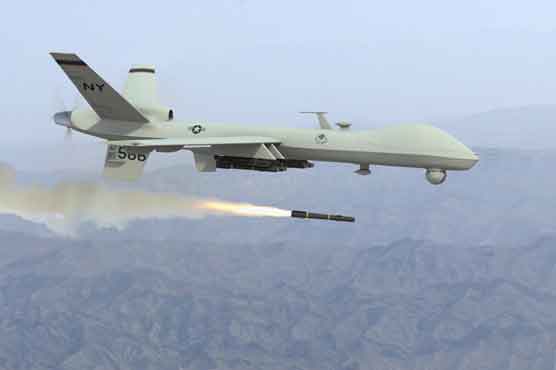
Summary Congressman Dennis Kucinich has urged upon his colleagues to act for stopping drone attacks.
While addressing the first ever Congressional briefing that he hosted at the Capital Hill on Friday, Congressman Kucinich (Democrat from Ohio) made clear that drone attacks were without any legal and moral justification as well as congressional oversight and due process of law. "This helps increase terrorism and recruitment by militants", he said adding that all parties in US should speak against this practice.
"We cannot let it continue like that, because it is against all international and US laws", he emphatically said while regretting that the US Congress had failed to fulfill its constitutional responsibilities in this matter. "The use of armed drones at a sovereign country is an act of war. You cannot call it any other way. Under the US constitution, Congress alone has the authority to declare war", he said while pointing out that the "US is not at war with Pakistan, Somalia or Yemen where these drone attacks are being carried out".
"The reasons given by the government and the CIA to justify drone strikes are untrue. It is my duty to talk about it because the Presidency has achieved a dominant role in this case and is undermining Congress", he remarked."Drones used for combat against other countries should not exist. This is aggression and does not justify the notion of national defense", he went on to emphasize.
The Congressman cautioned that the day was not far when such drones would be overused and there was a need to act and stop it now. He also slated the plans of the US administration to use surveillance drones domestically. "Congress has to be reminded what its constitutional role is, and to stand up for its responsibilities", he hoped.
It may be mentioned here that Congressman Kucinich has not only been quite vocal against drone attacks of late but also instrumental in rallying around 26 Congressmen, who - along with Kucinich -signed and wrote a letter to the President in June 2012 to seek explanation on drone programs.
Testifying on the occasion, James Cavallaro, Professor of the Harvard University Law School, who recently also compiled a report on Drone casualties in Pakistan, said that only two percent high-value targets were taken out in drone attacks since 2004 while more than 8000 civilians had been killed. "This can't be allowed to go on like this because this revenge feeling helps militants recruit others", he opined. He also cited drone attacks as the reason for increasing anti-American feelings in Pakistan. "As many as 76 countries including China and Iran have drones now, and may be militants will have it as well. Will we allow them to use drones as well?", he questioned.
Frank Jannuzi, Deputy Executive Director of Amnesty International, said that the US policies for extra-judicial killings were in violation of all international laws. "The US treats the entire world as a legal battlefield which is a cause of concern for international human rights organizations", he bemoaned. "The idea of self defense needs more scrutiny", he said adding that the way it was being carried out now was more damaging for the credibility of the US. "The US must disclose legal and factual details and allow full and independent investigations", he urged.
Medea Benjamin, cofounder of code pink and author of the book titled "Drone warfare: killing by remote control", who also led a 34 person delegation from the US to Pakistan for participation in Imran Khan's anti-drone peace march to North Waziristan, narrated her personal encounters with the victim families. "These attacks are actually jeopardizing national security interests of the US and sowing seeds of violence for many years to come", he decried.
The Pashtun culture of revenge and intense anger within the society overall was a reflection that these attacks were considered an attack on Pakistan's sovereignty, Media observed and stated that the onus was now on Congress and the US civil society to push back against the governmental actions. While giving the example of public reaction in Pakistan over the Taliban attack on Malala Yusufzai, she said that this was enough proof that the majority of Pakistanis were against militancy. "We need to win hearts and minds and make peace with Muslim neighbours", she advised.
Bob Naiman, Foreign Policy Columnist said that the issue of drone attacks had become very controversial within the US and the around the world. "There is untapped demand by people for explanation of this strategy. I am confident that there will be more activity in this regard during next year", he believed adding that the US administration had a tendency to neglect Congressional oversight.
"There is a need to change political psychology that Congress cannot do anything about it", he said adding that such hearings and other measures taken by the US legislators could go a long way in making the Us government accountable for drone warfare. "Most Americans have no idea what the drone policy is. So it is inaccurate to assume that the general public is not against this practice", he argued.
Contributed by Awais Saleem, Dunya News correspondent in Washington, DC