Summary The real difficulty was to balance out the thought and social commentary with hardcore entertainment
By Mahwash Ajaz
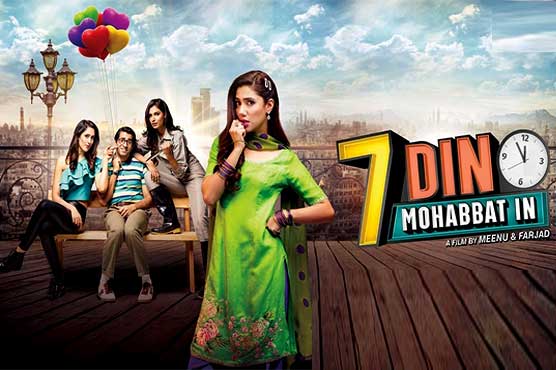
From the release of Zinda Bhaag, the critically acclaimed 2013 Pakistani film, Meenu and Farjad made heads turn. Many call it one of the best films to come out of Pakistani cinema and the filmmaker duo recently released Mahira Khan and Sheheryar Munawar starrer Saat Din Mohabbat In which is still running in cinemas. Mahwash Ajaz caught up with this dynamic duo for Dunya News to speak about the expectations and their current state of mind after 7DMI.
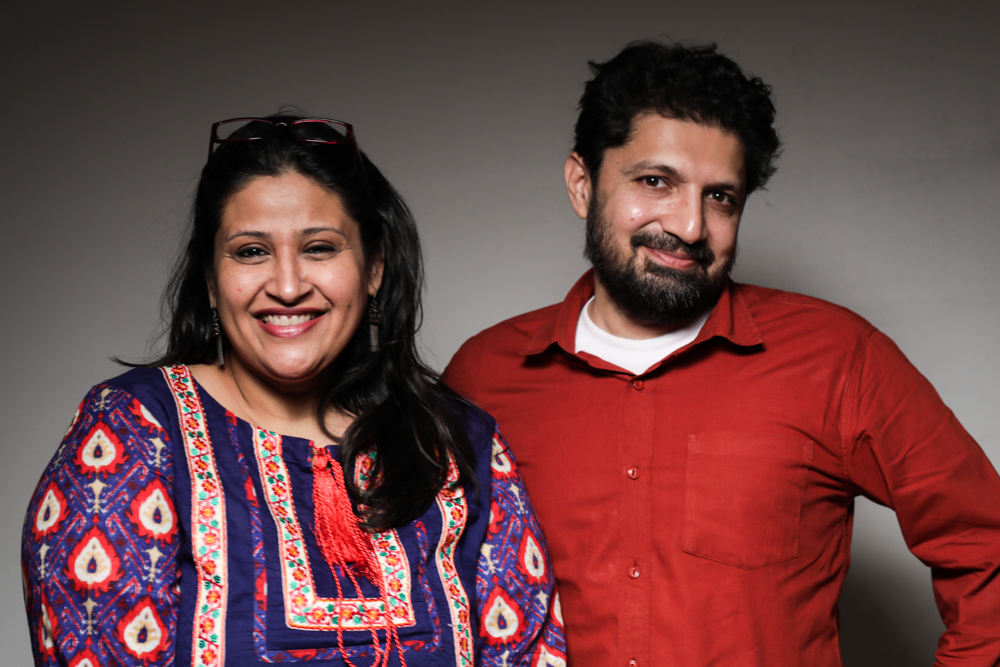
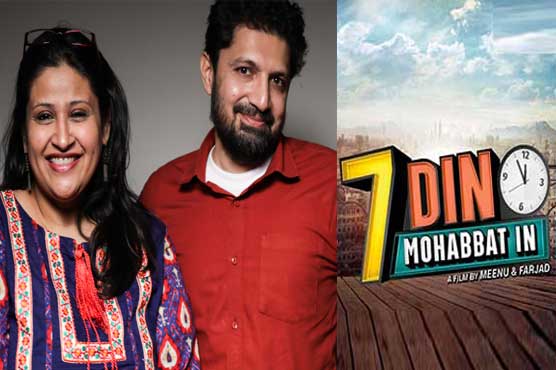
Meenu and Farjad, the 7DMI duo, in a candid converstaion. Photo: Mahwasj Ajaz for Dunya News
1. How has the response been so far for SDMI? How have you been feeling about it?
Farjad: We re thrilled! The response is much beyond our expectations.Its been a solid box office opening. The reviews have been nothing short of stellar! Each and every one of the reviews is so fantastic and actually gets what we set out to do. So the feeling is of excitement, sense of victory, after fifteen months of a crazy and rigourous work schedule, the success of the film feels particularly sweet. Everybody involved in this film from the editor, actors, VFX will tell you what a difficult film this was to make. It was tough not only because of its ambition but because of the genre mixing. And when you try something new and that too for a wide release film its a bit risky. So when we read the reviews and saw the audience reaction and realised that people had entered and accepted the universe we had created it was pure delight.
Also Read: Review: Saat Din Mohabbat In, A delightful formula-movie to boost cinema
2. How difficult is it to write and cast for a Pakistani audience that is still finding its taste and its groove? Some people say it s easier because of how new and fresh everything is, so you can always make your own rules and be pioneers.
Meenu: It has it pros and cons. On one hand even something new and experimental reaches the audience because the market is not yet saturated but on another unlike Hollywood and Bollywood there isn t yet an appetite for trying too many new things because people really want to play it safe because its still a struggling industry. In this context it is particularly important that 7DMI clicked. Because at the end of the day it is a mainstream masala film but also very experimental. I say experimental because it takes massy mainstream conventions and tries to incorporate and yet subvert them at the same time. It takes stereotypical tropes and deploy them to another purpose. Its a comedy but its politics is progressive. Its a realistic film but it is fantastical. Its masala but with a lot of quirks. So the real difficulty was to balance out the thought and social commentary with hardcore entertainment.
3. Tell us about the journey you both took to come to the world of mainstream Pakistani cinema? The numbers, the PR machinery, the big money are all involved in making a bigger film and a more commercial film so to speak?
Farjad: For a special effects heavy film which was star-studded etc. I still think we pulled it off in a very moderate budget. Working in challenging budgets though is good for the makers because it really pushes you to do your best. I think Pakistani films at this time have no choice but to work on moderate budgets. To be honest nothing much changes... in Zinda Bhaag we faced different kind of challenges and with this there was another set of challenges. Having done both kinds of films, more art house and now more mainstream, I can say with confidence what I always suspected, there is no big difference. The budget will always be a limitation and you will always have to work within it.
Also Read: Eid Hit Saat Din Mohabbat In continues to enthrall fans
.jpg)
4. Where do you see the Pakistani film industry at the moment, and how do you see its future?
Farjad: The industry is growing but in fits and starts. A few films do very well and then there is a silence. On the other hand there is no fixed government policy so the measures taken to support the industry are purely arbitrary. That said, we are living in exciting times and it s truly a privilege to be making films right now. We just need to sustain the momentum for a number of years to form a solid industry.
"there is no fixed government policy so the measures taken to support the industry are purely arbitrary."
5. How does a director retain their vision when they ve got a lot of other markers and demands trying to create or shape the content or your film in a certain way? Is the final product very different from what you envision in the first place?
Meenu: Farjad had the idea of this film in 2005 and at that time we had sketched out most of its details. From the beginning the idea was to take very massy archetypes from folk, punjabi stage and old Lollywood and subvert them. So you have a dwarf who is in fact the debonair and dandy man and his masculinity is not defined by his height. You have a feminist character who saves the hero and heroine in the end. A transgender who is in fact one of the heroines in the film and despite the hero having that knowledge when he looks at her there are fireworks going off in the sky thereby underlining the chemistry between them. And the feminist group Aurat Zaat ki Laat, is an ode to Rangeela s Aurat Raaj, a revolutionary film of its time. The film is one of Pakistani cinemas cult classics and has at its core a very simple and yet radical feminist proposition. Apart from that the character of the feminist heroine this was also an opportunity to play out one of my feminist fantasies on screen. So this was our agenda and other half of it was to package it in relentless entertainment. This is what we started with and in the end this is more or less what we got. However, in filmmaking their many demands and contingencies which shape the film. I would say in the end a large part of a directors job is to balance myriad expectations with their original intention.
"The film is one of Pakistani cinemas cult classics and has at its core a very simple and yet radical feminist proposition."
6. What is the measure for success? Box office, an organic audience response or critical acclaim? If you had to rank them in order of the most desired or accurate measure of acceptance for your work, how d you rank them?
Farjad: Meenu and I have a policy that before the release of the film we decide what we want from it and then we measure our success or failure against that. We do that because desires are endless. If you get rave reviews then you want box office, if you get box office but you want rave reviews, you get rave reviews and box office and then you want worldwide recognition and so and so forth. So I won t rank them but I will say its best to mark your goalpost. This helps Meenu and me to stay satisfied and thereby prolific.
7. What advice would you give to budding filmmakers and directors?
Farjad: First, If you are a filmmaker then invest your energies in making films not just talking about other films and what is wrong with them. I feel the latter is a trap that one should avoid as you keep raising the stakes for yourself to an impossible level. Its best to accept that to be a master of cinema you will have to go through a vast body of work first and that won t happen if you never take that first step. Also don t be too precious about making work, some of your films will get praise some won t, some will make money some won t, but there is no worse fate than not making films for a filmmaker... just keep making them. And finally, don t make films to audience expectations, reviews, or market demands because you can t second guess either of them so just go with the work that gives you joy. If you re a filmmaker you will be forgiven for making some bad films but you will not be forgiven for not making any films!
"Don t be too precious about making work, some of your films will get praise some won t, some will make money some won t, but there is no worse fate than not making films for a filmmaker"
8. What are your next projects? What are the kind of projects you d really like to do? Is there a specific cast/team that you d like to work with in the future?
Farjad: We have a lot many scripts ready. Meenu and I keep writing scripts, so we have a suspense thriller ready, we have an historical epic drama almost ready, a children s film and of course a very art house noir film project that we took to Locarno and Berlinale this year which is in development. My Zinda Bhaag crew is still my dream crew and I actually can never forget what my Asst. Director, cinematographer, editor and everybody really did for that film. I have not been able to repeat that crew again due to many extraneous circumstances but in an ideal universe I would like to re-create that energy of the Zinda Bhaag film set again... it really was something else. However on 7DMI we were very lucky to work with the top professionals in Pakistan, it is a star studded in that respect as well.
9. What have been your favorite Pakistani films to have been made in the last fifteen years?
Meenu: I love the way contemporary Pakistani cinema has some directors with their own distinctive styles and signatures. That is actually quite an exciting facet of what is going on. I liked how unpredictable the plot of Bol by Shoaib Mansoor was. We are fans of old Lollywood as would be apparent with how much of a stylistic ode we keep making to it in our films. I think both Farjad and I are taken up with folk and not necessarily classical folk but also in its more corrupted forms. There will always be a folk story telling style going on in our films. So for instance the character of Puhlwan in Zinda Bhaag was a classical folk trope in as much as he narrated parables within a larger story universe. Similarly the character of Dwarka in 7DMI is inspired by the the folk tradition of the Behrupiya or the impressionist. Its a dying folk tradition in the region but one that fascinates us.