Summary NZ style is based on calculated risk, bravery and a happy-go-lucky approach.
LEEDS, England (AP) Tim Southee walked to the middle, poked the pitch with his bat, adjusted his helmet and faced the first ball of his innings. He swung and missed and chuckled to himself. Next ball? Exactly the same. And the next.
Granted, Southee is one of the most aggressive batters in New Zealand s lineup the fast bowler s unbeaten 70 off 44 balls on his test debut in 2008 contained nine sixes but his attitude is symptomatic of the Black Caps approach to test cricket these days.
New Zealand is changing the face of the longer version of the game. Test cricket is dying, the critics say, pointing to the proliferation of the Twenty20 format.
Not the way New Zealand plays it.
Cricket s authorities have been considering proposals about how to enhance the public appeal of cricket s oldest format. At a meeting last month, the International Cricket Council discussed the introduction of day-night test matches, and the concept of four-day tests was also raised.
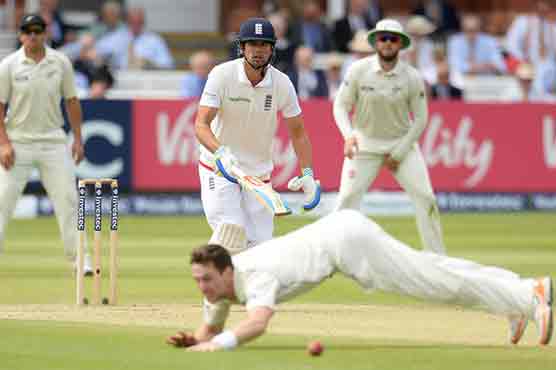
New Zealand s players, it seems, have their own idea. Under captain Brendon McCullum, they are playing limited-overs cricket over five days, and it is making for the most entertaining test matches.
"See ball, hit ball," was how New Zealand batsman Luke Ronchi described his approach during the second test against England at Leeds, which is into its fourth day.
In the series against England, which sadly is only two matches long given the excitement being generated, New Zealand has scored 1,547 runs in four innings. On Monday, the tourists raced along at 7.25 runs an over before declaring at 454-8 in its second innings, which included 49 fours and nine sixes.
"I am a traditionalist," Christopher Rigby, a 78-year-old retired surgeon who has been watching cricket since the 1940s, told The Associated Press on Monday as he watched play. "But I don t think you can grumble at what we are seeing. It s entertaining for the spectators, as well as being good for the game of cricket."
Many of the New Zealand team missed the warm-up games for the test series and flew into England only days before the first test because they were playing in theT20 Indian Premier League. It seems the format is still in their system.
McCullum, the architect of New Zealand s approach, hit the first ball he faced in the Leeds test for six on Friday. Southee clubbed Stuart Broad for 20 off one over on Monday. Faced with a tough situation of 23-2 on Sunday, Martin Guptill and Ross Taylor raced along at a run rate of 6.82 an over in a 99-run stand.
For some Yorkshire folk in the crowd, like Rigby, who grew up on a diet of forward defensives from one of the county s most famous players, former England batsman Geoff Boycott, it is a radical departure from typical test cricket.
New Zealand s style is based on calculated risk, bravery and a happy-go-lucky approach. And it s not to everyone s liking.
"I m a purist and I like to see good tests, with good skills," England bowling coach Ottis Gibson said. "When you watch this cricket, if you score at five runs an over you will be taking risks. I don t know what to make of it all."
McCullum said he makes "no apologies about how we play the game."
"We need to play an aggressive style of cricket," he says. "There are times we ll get beaten, but it s our greatest chance of success."
It s working, though. New Zealand hasn t lost any of its last six test series and its game plan has unsettled England over the past two weeks.
England s bowling attack has been thrown off kilter and captain Alastair Cook has had to change his field placing on a regular basis. Put simply, England just hasn t known where to bowl at New Zealand.
The question now is how many teams will follow New Zealand s example. Australia already plays an aggressive brand of cricket and England has adjusted its style in an attempt to keep pace with New Zealand s this series. Could the likes of India and Sri Lanka
other powers of limited-overs cricket do the same?
"I think it s very unlikely," Mark Nicholas, a television cricket commentator in England and Australia, told the AP. "People may have a crack at it and teams may play a little more positively. But I don t think anybody will go down the road of laissez-faire."
One thing is for sure, though. New Zealand isn t for changing, at least in the current regime.