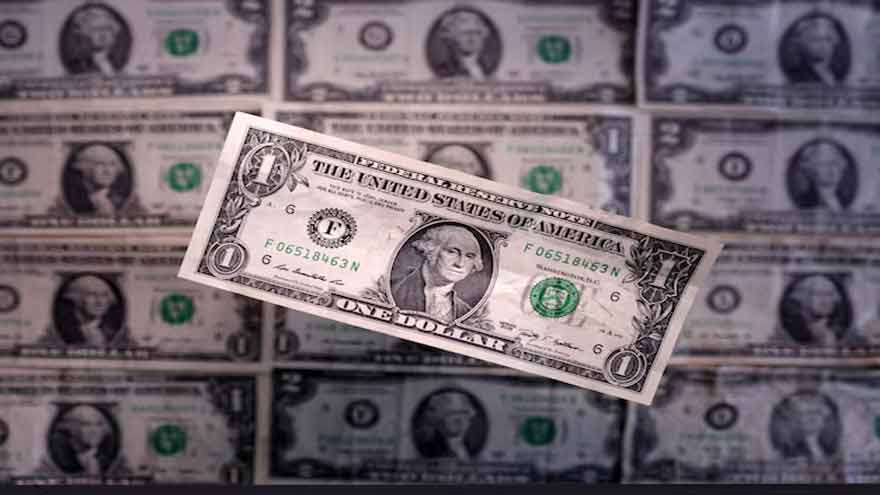
Summary The U.S. dollar stayed near its yearly highs as rising oil prices and Middle East tensions fueled inflation fears, pushing currencies like the euro, yen, and pound lower.
SINGAPORE (Reuters) - The safe-haven U.S. dollar hovered close to its strongest levels this year on Thursday as climbing oil prices threatened to spur inflation and force central banks globally to adopt more hawkish policy stances.
The euro fell 0.1% against the greenback to $1.1549 in early Asian trading, nearing its lowest level since November.
Japan's yen briefly declined past the 159-per-dollar mark, easing as much as 0.2% to 159.23 and approaching its weakest level since July 2024.
The Australian dollar dropped 0.1% at $0.7148, while the New Zealand dollar slid 0.1% to $0.5907.
The British pound was down 0.2% at $1.3385.
Oil market volatility continued to climb with Iran saying the world should be ready for crude at $200 a barrel as its military attacked merchant ships on Wednesday and vessel traffic through the Strait of Hormuz dwindled to a trickle.
The surge in oil prices as the supply outlook worsens will push up energy costs and crimp global growth, economists warn, with the risks rising as the duration of the conflict lengthens.
U.S. President Donald Trump said on Wednesday that Washington was in "very good shape" in its war on Iran, and the U.S. was "going to look very strongly at the Straits."
However, three sources familiar with the matter told Reuters that U.S. intelligence indicates that Iran's leadership is still largely intact and is not at risk of collapse any time soon after nearly two weeks of relentless U.S. and Israeli bombardment.
"President Trump keeps on saying, even overnight, that the war will end soon - it's unclear to us that it's really up to him," said Rodrigo Catril, a currency strategist at National Australia Bank in Sydney.
"We should expect ongoing volatility in energy prices," he said on a podcast.
"The Strait of Hormuz is not just about oil, it's about LNG, it's about fertilizers," he added. "The longer that there's no ability to go through, the pressure on prices will continue."
Brent crude rose 6.9% to $98.30 at the start of Asian trading, even after the International Energy Agency on Wednesday agreed to release a record 400 million barrels of oil from strategic stockpiles to combat a spike in global crude prices.
A gauge of oil market volatility from Cboe (.OVX) which has risen for seven out of the eight trading sessions since the conflict began, surged on Wednesday to 121.01, shooting to the highest levels since 2020, in the early days of the pandemic.
Risk appetite took a further hit after U.S. President Donald Trump's administration on Wednesday launched a new trade investigation into excess industrial capacity in 16 major trading partners in a move aimed at rebuilding tariff pressure after the U.S. Supreme Court struck down the centerpiece of Trump's tariff program last month.
"U.S. breakeven inflation and swap spreads are on the march wider," analysts from ING wrote in a note to clients, adding that in the euro zone the 10-year swap rate is also heading for 3%.
Swaps pricing indicates traders expect central banks to tighten monetary policy faster than previously thought. The European Central Bank is now seen hiking as soon as June, while the Reserve Bank of Australia may hike both at its meeting next week and again in May, according to LSEG data.
Fed funds futures show reduced odds that the Federal Reserve will ease policy this summer, with an implied 50.7% probability that the U.S. central bank will refrain from a cut at its July meeting, compared to a 43.4% chance a day earlier, according to the CME Group's FedWatch tool.
Against the Chinese yuan , in offshore trade the U.S. dollar was flat at 6.8766 yuan.
Bitcoin fell 0.6% at $70,231.21, while ether slid 0.8% to $2,053.31.