Summary Farmers report savings with new irrigation technology
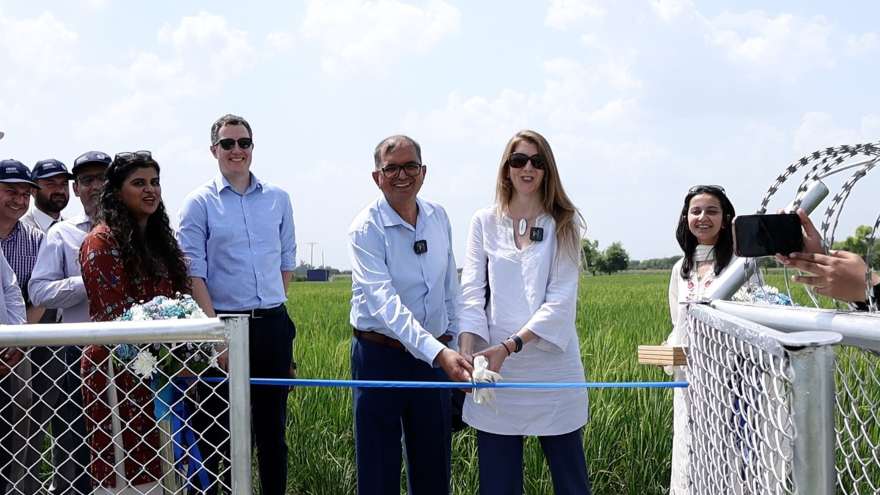
LAHORE (PR) – British High Commissioner to Pakistan Jane Marriott on Wednesday visited Okara to inaugurate an Eddy Covariance Flux Tower system, installed through funding from the UK’s Foreign, Commonwealth & Development Office (FCDO).
The project is part of the Water Resource Accountability in Pakistan (WRAP) programme, implemented by the International Water Management Institute (IWMI).
The flux tower records real-time data on water, carbon, methane, and energy exchanges between farmland and the atmosphere. This data is already being used by the Punjab Irrigation Department to refine water allocation and by the Ministry of Climate Change and Environmental Coordination to enhance Pakistan’s greenhouse gas reporting for agriculture. Strengthening these systems is essential for the country to meet its international climate obligations.
Smart tools for farmers
During her visit, Marriott was shown Soil Moisture Sensors that are being introduced to local farmers. These affordable devices help growers decide the right time to irrigate their crops, lowering water and electricity consumption while boosting yields. Farmers in Okara have already reported both cost savings and productivity gains, illustrating the value of applying simple technology to farming.
The visit coincides with severe flooding in parts of Pakistan, once again underlining the urgent need for evidence-based research and technology that can support forward-looking climate planning.
Advancing climate reporting
Dr Mohsin Hafeez, Director of Water, Food & Ecosystem at IWMI and Project Leader for WRAP, explained that Pakistan’s devastating floods highlight the reality of climate change as an immediate threat. He said the WRAP programme is designed to equip the country with tools that enable proactive, evidence-based planning, from flux towers to irrigation sensors.
Jane Marriott echoed the message, stressing that shifting from reactive responses to proactive planning is critical. She highlighted that the WRAP programme is showing how science-backed innovation can protect lives and rural livelihoods.
Data from the flux towers is now being integrated with satellite observations, improving national estimates of water use, carbon balance, and methane emissions. This innovation moves Pakistan from approximate figures to scientifically validated, locally adapted greenhouse gas inventories. Such progress not only enhances reporting under the Paris Agreement but also improves access to international climate finance.
By linking climate-smart farming practices with transparent water accounting, the WRAP programme is positioning Pakistan to improve food and water security while strengthening delivery on its Nationally Determined Contributions.