Summary Beijing's surprise devaluation of the yuan sent ripples through global financial markets.
HONG KONG (AFP) - Asian shares fell on Wednesday after China cut the yuan s value against the dollar for a second day, fuelling concern about the world s number two economy and driving expectations the currency could fall further.
The dollar declined slightly in Tokyo trade, after rising on news the People s Bank of China (PBoC) had again reduced the value of the yuan against the greenback, trimming the reference rate by 1.62 percent.
Beijing s surprise devaluation of the yuan by 1.86 percent on Tuesday sent ripples through global financial markets, prompting a wave of selling in equities and commodities and hitting Asia-Pacific currencies.
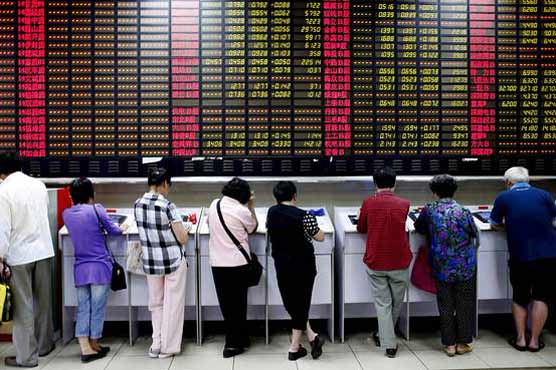
Hong Kong was down by 1.99 percent Wednesday while Shanghai clawed back most early losses to trade down 0.14 in mid-afternoon trade.
Other regional markets also lost ground, with Tokyo closing down 1.58 percent, or 327.98 points, at 20,392.77, while Sydney ended 1.66 percent lower at 5,382.10. Seoul closed down 0.56 percent, or 11.8 points, at 1,975.47.
After Tuesday s devaluation Chinese authorities said they were seeking to push market reforms in a one-time move.
Officials will now use the previous day s close, foreign exchange demand and supply and the rates of other major currencies to decide the daily rate around which the Chinese currency can trade.
But investors feared Beijing s move signalled concern over growth after weekend data showed a fall in trade and weak inflation.
"Today s weak fixing indicates the PBOC wants to see further depreciation in the yuan, as yesterday s drop won t be enough to prop up China s exports," Kenix Lai, a foreign-exchange analyst at Bank of East Asia in Hong Kong, told Bloomberg News.
"Capital will flee from China to the US due to the economic slowdown and the yuan devaluation."
China-focused stocks fall
Wall Street tumbled Tuesday on the initial devaluation, with the Dow Jones Industrial Average, S&P 500 and Nasdaq Composite Index all closing down around one percent or more.
Companies which rely on China as a major market were hit particularly hard, with Apple dropping 5.2 percent and General Motors 3.5 percent.
In Tokyo share trading Wednesday, automaker Toyota fell 1.66 percent to 7,987 yen, while Nissan, also dependent on China for sales, dropped 2.09 percent to 1,168.5 yen.
Commodities also lost ground on concerns that demand is set to fall in Asia s biggest economy -- a major importer of energy, metals and grains -- with oil sinking to a six-year low.
Analysts said oil prices came under further pressure Wednesday from news the OPEC producer cartel raised output in June, adding to a global supply glut, and ahead of US stocks data due later in the day.
US benchmark West Texas Intermediate for delivery in September was at $42.98 a barrel on Wednesday, after hitting $43.08 in New York -- the lowest level since March 2009.
European benchmark September Brent fell to $48.89, from $49.18 a barrel in London.
Safe-haven gold fetched $1,114.38 compared to $1,110.35 late Tuesday.
In Tokyo forex trade, the dollar fetched 125.00 yen Wednesday afternoon, down from 125.12 yen in New York late Tuesday.
Bhaskar Laxminarayan, chief investment officer of Pictet Wealth Management Asia, added that a "further gradual renminbi depreciation is now likely, and other regional currencies now face downwards pressure".
The euro, meanwhile, strengthened to $1.1088 and 138.46 yen compared with $1.1042 and 138.15 yen in US trade, after Greece s government agreed the text for a 85 billion euro ($94 billion) international bailout.
In individual results, Commonwealth Bank of Australia said full-year net profit rose five percent to a record Aus$9.063 billion (US$6.62 billion). Shares halted trading ahead of a Aus$5 billion capital-raising.
The Hong Kong stock exchange said its first-half earnings surged 73 percent to a record high as it reaped the benefits of a link-up with the Shanghai bourse.
In other markets:
-- Wellington fell 1.12 percent, or 65.14 points, to 5,757.21.
Spark New Zealand was 2.46 percent off at NZ$2.77 while Fletcher Building closed 2.05 percent down at NZ$7.64
-- Taipei fell 1.32 percent, or 110.76 points, to 8,283.38.
Taiwan Semiconductor Manufacturing Co. dropped 1.53 percent to Tw$128.50 while Hon Hai Precision Industry lost 2.26 percent to Tw$86.50.
Bangkok was closed for a public holiday.