Summary Monday's 8.48 percent fall in Shanghai was the biggest drop since February 27, 2007
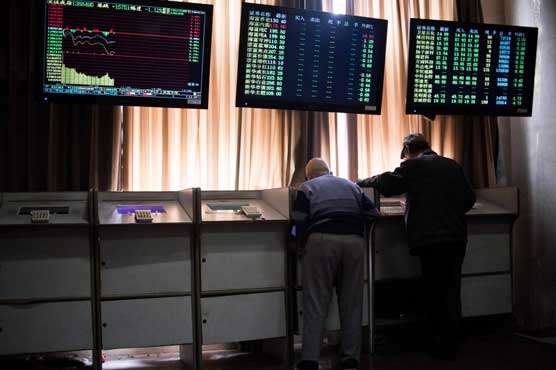
SHANGHAI (AFP) - Chinese shares sank Tuesday morning, a day after Shanghai s steepest slide in eight years, defying renewed government vows of support that analysts warned were not enough to settle nervous investors.
The fresh losses, in a volatile session, came despite an unprecedented effort by the government of the world s second largest economy to shore up prices following a month-long rout.
The recent turmoil followed a stock boom encouraged by the authorities, and their willingness to intervene in the market has raised questions over their commitment to economic reforms.
The benchmark Shanghai Composite Index slipped 1.0 percent, or 37.08 points, to 3,688.48 by the break. It gyrated heavily during the session, falling as much as 5.0 percent and rising almost one percent into positive territory.
Monday s 8.48 percent fall in Shanghai was the biggest drop since February 27, 2007.
The Shenzhen Composite Index, which tracks stocks on China s second exchange, dropped 1.30 percent, or 28.16 points, to 2,131.93.
Some of China s legions of small investors -- who dominate the market, unlike most exchanges worldwide, where institutions are the largest stockholders -- say they are heading for the exits.
"I sold 90 percent of my stocks since I saw several reports saying that the market is due for a correction," said Ling Lihui, a manager at a market research company, who sold last week.
After Monday s collapse, the China Securities Regulatory Commission (CSRC) said it would continue to "stabilise" prices.
The state-backed China Securities Finance Corp., tasked with supporting the market, would increase its share holdings, the CSRC said in a statement.
- Decline delayed -
=====================
But analysts warned the comments might not be enough without concrete action.
"The government s current intervention was not able to stop the market s slide and only delayed the decline," Castor Pang, head of research at Core-Pacific Yamaichi Hong Kong, told Bloomberg News.
The government intervened after the market plunged more than 30 percent in just under four weeks from mid-June, having risen more than 150 percent in the previous 12 months.
Early efforts failed to change sentiment, until the government banned shareholders with more than five percent stakes from selling stock and launched a police crackdown on short-selling.
The China Securities Finance Corp., previously a largely unknown financial institution which helped provide financing to brokerages, has also amassed a war chest of funds to buy stock to intervene on the exchanges, media reports say.
The market rallied for six sessions until Friday, when an independent survey of manufacturing activity hit a 15-month low in July.
Some analysts believe the market rout has yet to become a crisis in the banking system, but warn it could have an impact on economic growth.
China s economy expanded 7.4 percent last year, the weakest pace since 1990, and slowed further to 7.0 percent in each of the first two quarters this year.
"The stock market will continue to be very volatile despite the high-profile rescue package launched by the government in the past few weeks," ANZ said in a research report on Monday.
"However, we do not regard price movement in the equity market (as) a financial crisis," it said. "The equity market rout provides room for the PBoC (People s Bank of China) to ease monetary policy."