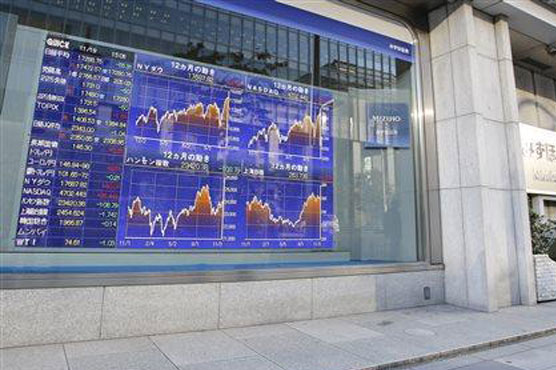
Summary The dollar was 117.12 yen on Thursday against 117.18 yen.
HONG KONG (AFP) - Concerns about Greece s plans to renegotiate its bailout rattled Asian markets Thursday and put pressure on the euro, while Shanghai and Hong Kong reversed early gains despite China cutting the amount of funds banks must hold in reserve.
Traders mostly took their cue from New York, which was hit by news that the European Central Bank would not allow Greek lenders to use government bonds to borrow cash, cutting off much needed access to liquidity.
Tokyo tumbled 0.98 percent, or 174.12 points, to finish at 17,504.62 despite Sony surging 12 percent to a five-year high.
Sydney rose 0.58 percent, or 33.64 points, to 5,810.98 -- its 11th straight day of gains, while Seoul lost 0.51 percent, or 9.95 points, to 1,952.84.
Shanghai, which surged 2.45 percent during initial trade, ended 1.18 lower, shedding 37.59 points to 3,136.53.
Hong Kong was flat in late trade having jumped of 1.4 percent just after the opening bell.
Under the terms of its bailout Greece s banks had been given a waiver to use government bonds -- which have a junk rating -- as collateral as long as Athens stuck to its obligations. The anti-austerity Syriza party last month won a general election on a promise to renegotiate the terms of its debt repayments.
The announcement came hours after new Greek Finance Minister Yanis Varoufakis held talks with ECB chief Mario Draghi, in his latest stop during a Europe-wide charm offensive looking to drum up support for a new deal.
It also comes as Varoufakis prepares to meet his German counterpart Wolfgang Schaeuble Thursday. The meeting will be closely monitored as Germany, the eurozone s main paymaster, is the strongest opponent of any easing in the bailout terms.
However, Athens said the move will have "no adverse impact" on its financial sector, saying it would be "fully protected", with other liquidity channels still available.
Nevertheless, traders were spooked. The Dow, which had surged during the day, ended flat, while the S&P 500 fell 0.42 percent and the Nasdaq lost 0.23 percent.
The euro ended Wednesday at $1.1334 and 132.81 yen in New York, from $1.1470 and 135.00 yen earlier in Asia.
On Thursday in Tokyo the single currency bought $1.1337 and 132.78 yen.
The dollar was 117.12 yen on Thursday against 117.18 yen.
Shanghai sank despite China s central bank on Wednesday cutting the percentage of cash lenders must keep in reserve to kickstart the mainland economy. It was the first across-the-board cut since May 2012.
Official data last week showed the economy in 2014 grew at its slowest pace in 24 years, while two separate gauges indicated manufacturing activity shrank in January.
It is also the latest move by authorities to juice the economy after the bank in November unveiled a surprise cut in interest rates.
"The move is aimed at helping the real economy and should boost lending to the private sector," Zhou Hao, a Shanghai-based economist at ANZ told Bloomberg News.
"It s likely that there will be another reserve-requirement ratio cut early in the second quarter."
On oil markets US benchmark West Texas Intermediate for March delivery was down 77 cents at $47.68 a barrel and Brent crude for March eased 71 cents at $53.45.
Gold fetched $1,270.18 an ounce, against $1,267.80 on Wednesday.
-- Taipei was flat, edging down 1.87 points to 9,512.05.
Taiwan Semiconductor Manufacturing Co fell 0.34 percent to Tw$145.5 while Hon Hai Precision Industry closed 0.23 percent lower at Tw$87.3.
-- Wellington added 0.21 percent, or 12.28 points, to 5,797.59.
Air New Zealand was up 1.97 percent at NZ$2.59 and Spark lifted 0.87 percent to NZ$3.49