Summary Oil prices edged back a touch after surging on Tuesday on renewed fears.
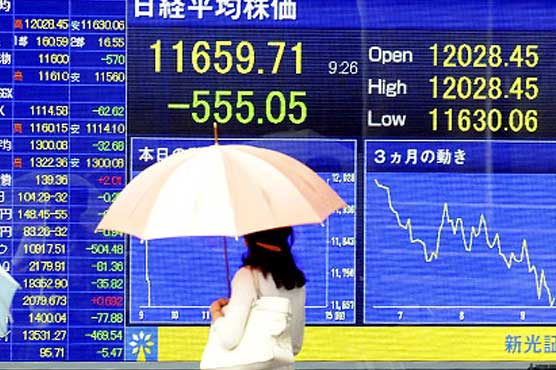
HONG KONG (AFP) - Asia s markets mostly rose on Wednesday following a slight rebound on Wall Street but Tokyo took another hit as the yen rallied after the Bank of Japan said it would not extend its stimulus in the near future.
Oil prices edged back a touch after surging on Tuesday on renewed fears about tensions in Ukraine while Australian shares were supported by a surge in retailer David Jones after it received a takeover offer valuing it at almost US$2 billion.
Tokyo tumbled 1.82 percent by the break but Hong Kong added 1.37 percent, Sydney was 1.00 percent higher, Shanghai gained 0.23 percent and Seoul was up 0.15 percent.
In New York the three main indexes enjoyed a pick-up after suffering three successive sessions of losses that were led by the Nasdaq as investors feared that big-name tech firms such as Facebook, Google and Tesla were overpriced.
The Nasdaq -- which has lost more than five percent since the start of March -- jumped 0.81 percent, while the Dow edged up 0.06 percent and the S&P 500 rose 0.38 percent.
In Japan the Nikkei sank for a fourth straight session as the yen strengthened after central bank chief Haruhiko Kuroda dismissed any hopes of further monetary easing soon.
Kuroda told a news conference Tuesday that the economy was getting back on track as Prime Minister Shinzo Abe s big-spending, easy money policy drive kicks in.
He also sought to soothe fears over the higher sales tax that came in on April 1, saying it would not hurt a nascent recovery, despite warnings to the contrary.
- IMF call to avoid eurozone deflation -
========================================
That sent the yen higher Tuesday, sitting at 101.75 to the dollar late in New York, compared with 102.56 earlier in the day in Tokyo. On Wednesday in Asia the dollar was at 101.87 yen.
The euro bought 140.51 yen on Wednesday, a tad up from 140.44 yen late in New York but down from the 141.21 yen earlier Tuesday in Asia. The single currency was also at $1.3790 on Wednesday, against $1.3797 in US trade.
Adding to pressure on the euro were comments from IMF chief economist Olivier Blanchard, who said European Cental Bank action was needed "soon" to avert deflation in the eurozone.
"They are considering a number of measures (including) negative interest rates, quantitative easing, securitisation programmes of various sources," he told journalists at the launch of the IMF s World Economic Outlook report.
"I think they should all be looked at, and I know that the ECB is looking at them," he said. "And we hope that they will implement them as soon as they re technically ready to do so... Sooner is better than later."
Oil prices eased slightly after spiking Tuesday on events in Eastern Europe.
NATO on Tuesday warned Russia against further intervention in Ukraine after pro-Kremlin militants in the cities of Kharkiv, Lugansk and Donetsk seized government buildings. The activists vowed to vote on joining Russia in an echo of last month s referendum in Crimea that led to it being absorbed by Moscow.
With Ukraine a key conduit for Russian gas to Europe, traders fear that any disruption to supplies will send oil and gas prices skyrocketing.
New York s main contract West Texas Intermediate for May delivery eased 27 cents to $102.29 a barrel in early Asian trade and Brent North Sea crude for May was down seven cents to $107.60.
And in Sydney department store operator David Jones surged 23 percent as it said it intends to recommend a buyout from South Africa s Woolworths that values the Australian firm at Aus$2.15 billion (US$2.01 billion).
The offer of Aus$4 a share is a 25 percent premium to its closing price on Tuesday.
Gold fetched $1,312.35 an ounce at 0250 GMT, up from $1,312.13 late Tuesday.