Summary Regional security, ASEAN cooperation and skills development feature in discussions
ISLAMABAD (Web Desk) – Pakistan and Singapore have agreed to strengthen their longstanding diplomatic relations and explore fresh opportunities for economic cooperation following a series of high-level meetings between Singaporean Foreign Minister Dr Vivian Balakrishnan and Pakistan's political and military leadership on Friday.
During his engagements in Islamabad and Rawalpindi, Balakrishnan met Prime Minister Shehbaz Sharif, Chief of Army Staff and Chief of Defence Forces Field Marshal Syed Asim Munir, and Deputy Prime Minister and Foreign Minister Ishaq Dar. Discussions covered trade, investment, regional security, institutional cooperation and stronger people-to-people connections.
The diplomatic engagements come as Pakistan and Singapore mark 60 years of diplomatic relations in 2026, with both countries looking to translate their established political relationship into stronger economic and commercial partnerships.
Trade and investment opportunities
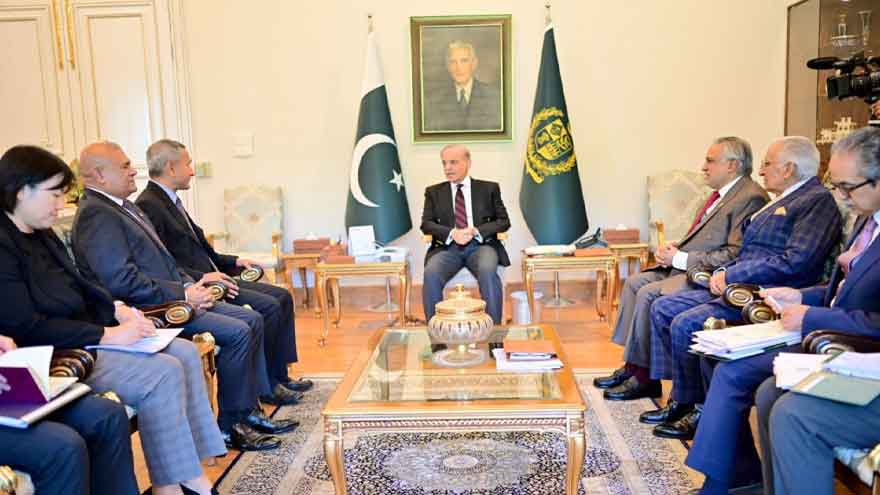
During his meeting with Balakrishnan at the Prime Minister House, PM Shehbaz reaffirmed Pakistan's commitment to expanding bilateral relations and strengthening cooperation across multiple sectors.
The two sides discussed opportunities to increase trade and investment, with particular attention to the digital economy, financial technology (fintech), infrastructure development, logistics, small and medium enterprises (SMEs) and the services sector.
The prime minister praised Singapore's economic transformation, particularly its achievements in innovation and development, and highlighted the importance Pakistan attaches to its partnership with the Southeast Asian country. He also emphasised the potential for expanding cooperation through the Association of Southeast Asian Nations (ASEAN), alongside bilateral engagement.
Minister for Foreign Affairs of Singapore Dr. Vivian Balakrishnan called on Prime Minister Muhammad Shehbaz Sharif in Islamabad, today. https://t.co/xjLQAD4Zva
— Prime Minister's Office (@PakPMO) October 30, 2026
Both sides explored new avenues for mutually beneficial economic collaboration and greater people-to-people contacts. They also exchanged views on regional and international developments, reaffirming their commitment to continued cooperation through bilateral and multilateral platforms.
Regional security discussions
Separately, Balakrishnan called on Field Marshal Asim Munir at General Headquarters (GHQ) in Rawalpindi, where the two discussed matters of mutual interest and the changing regional and global security environment.
According to the Inter-Services Public Relations (ISPR), the meeting focused on opportunities to strengthen bilateral cooperation, regional peace and stability, and continued engagement on issues of shared interest.
The top military commander reiterated Pakistan's commitment to developing stronger relations with Singapore, highlighting the importance of institutional linkages and constructive engagement in promoting regional peace, stability and security.
Singapore foreign minister calls on Field Marshal Asim Munir at GHQ
The Singaporean foreign minister reciprocated Pakistan's desire to deepen bilateral ties, appreciated the professionalism of the Pakistan Armed Forces and acknowledged the country's contributions to regional peace and stability.
Dar seeks stronger business links
Earlier, Deputy Prime Minister and Foreign Minister Ishaq Dar held detailed discussions with Balakrishnan on strengthening economic relations, expanding investment and improving connectivity between the two countries.
Dar observed that the depth of diplomatic relations between Pakistan and Singapore was not adequately reflected in their existing economic ties. He called for efforts to unlock the considerable potential for bilateral trade and investment.
Deputy Prime Minister/Foreign Minister Senator Mohammad Ishaq Dar @MIshaqDar50 and Singapore’s Minister for Foreign Affairs Dr. Vivian Balakrishnan addressed a Joint Press Stakeout at the Ministry of Foreign Affairs, Islamabad. https://t.co/liOQ1G7N6i
— Ministry of Foreign Affairs - Pakistan (@ForeignOfficePk) October 30, 2026
He expressed confidence that closer coordination between the two governments, particularly in facilitating businesses and investors, could take economic cooperation to a higher level.
Dar also highlighted the role of the Special Investment Facilitation Council (SIFC), saying its functions had been integrated into the Board of Investment to provide investors with a streamlined, one-window facilitation mechanism.
The deputy prime minister appreciated Singapore's contribution to capacity building in Pakistan, noting that nearly 1,500 Pakistani officials had benefited from the country's training facilities and development programmes.
He also called for the early conclusion of cooperation arrangements between Singapore's Institute of Technical Education and Pakistan's National Vocational and Technical Training Commission (NAVTTC), aimed at strengthening technical and vocational skills development.
ASEAN and direct flights
The two foreign ministers also discussed cooperation at international forums and Pakistan's enhanced engagement with ASEAN, particularly ahead of Singapore's scheduled chairmanship of the regional bloc in 2027.
Regional and international developments also featured prominently, with Dar emphasising the importance of dialogue and diplomacy in resolving disputes and promoting lasting peace and stability.
The discussions additionally covered Palestine, Jammu and Kashmir and matters relating to the International Court of Justice (ICJ).
Another key area of discussion was the possible resumption of direct flights between Pakistan and Singapore. Dar said the two countries had discussed restoring direct air connectivity to facilitate business travel, strengthen commercial links and encourage closer people-to-people contacts.
Improved connectivity, alongside cooperation in investment, technology, logistics and skills development, featured among the areas identified by both sides for advancing their bilateral partnership.