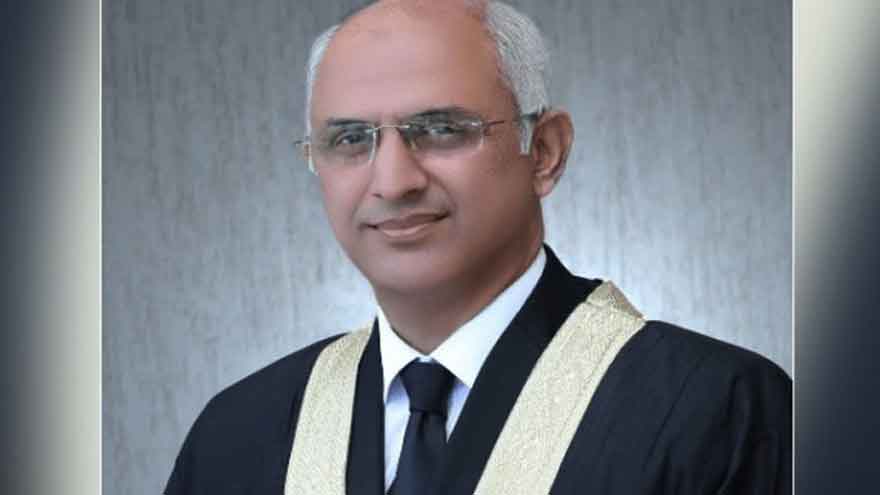
Summary Lahore High Court Justice Mohsin Akhtar Kayani has resigned. He was 10th on the court’s seniority list and was due to retire on February 11, 2032.
LAHORE (Muhammad Ashfaq) – Justice Mohsin Akhtar Kayani resigned as a Lahore High Court judge on Wednesday, citing health concerns and “reasons of conscience” as well as reservations over the 26th and 27th Amendments’ impact on judicial independence.
He said his years of judicial service had been among the most meaningful and fulfilling of his life. During his tenure, he had disposed of more than 23,000 cases of various categories, seeking to uphold the Constitution, safeguard fundamental rights and administer justice without fear or favour.
However, Justice Kayani said that, in his considered view, the changes introduced through the 26th and 27th Constitutional Amendments had compromised the independence and institutional integrity of the high courts.
He said he had witnessed what he regarded as growing executive control over judicial institutions, including the appointment and transfer of judges. According to him, such interference had seriously eroded public confidence in judicial independence and the fairness of the judicial process.
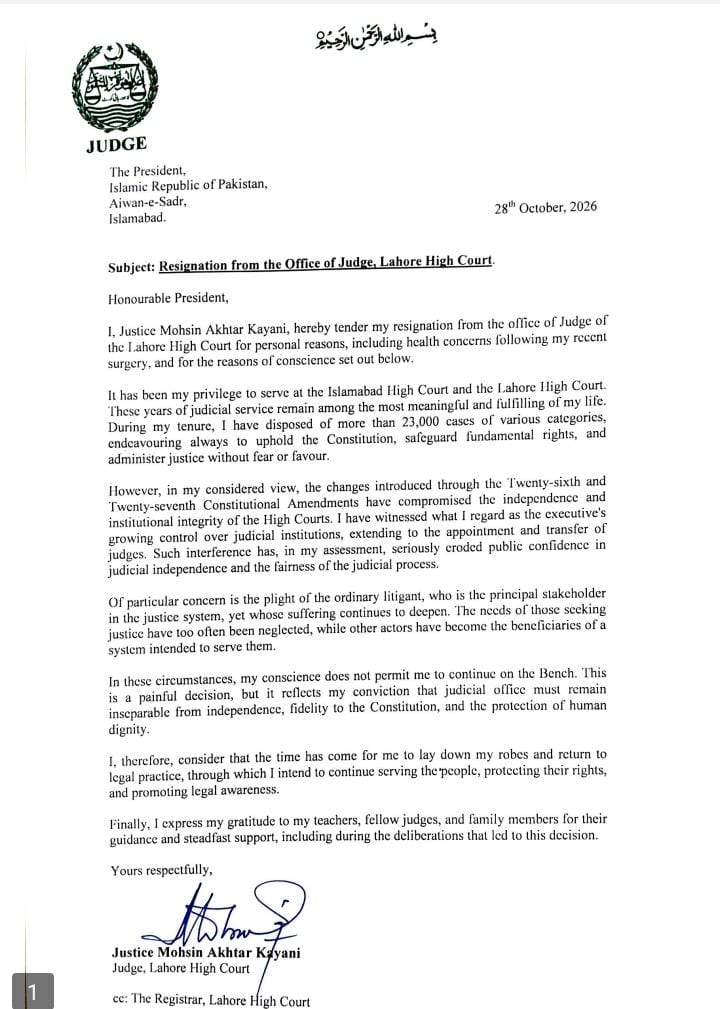
Justice Kayani also expressed concern over the plight of ordinary litigants, whom he described as the principal stakeholders in the justice system, saying their suffering continued to deepen.
He observed that the needs of people seeking justice had too often been neglected, while other actors had become beneficiaries of a system intended to serve the public.
“In these circumstances, my conscience does not permit me to continue on the bench,” he stated in his resignation letter, describing the decision as painful but consistent with his conviction that judicial office must remain inseparable from independence, fidelity to the Constitution and the protection of human dignity.
He said he had decided to leave the bench and return to legal practice, through which he intended to continue serving the people, protecting their rights and promoting legal awareness.
The judge concluded his letter by expressing gratitude to his teachers, fellow judges and family members for their guidance and steadfast support, including during the deliberations that led to his decision.
Judicial career and transfer controversy
Justice Kayani’s resignation comes days after he returned to the twin cities to preside over a single bench at the Rawalpindi registry following a reshuffle at the Lahore High Court.
Originally from Islamabad, Justice Kayani was transferred to the LHC in April this year and assigned to its principal seat in Lahore. Despite being a senior judge of the high court, he was not assigned to any division bench.
Before his transfer, Justice Kayani served as the senior puisne judge of the Islamabad High Court and was expecting to be elevated to the position of chief justice.
However, the transfer of Justice Sardar Muhammad Sarfraz Dogar from the Lahore High Court, along with two other judges from the Sindh and Balochistan high courts, prompted Justice Kayani to challenge the inter-high court transfers.
The Supreme Court’s constitutional bench upheld the transfers to the Islamabad High Court, including that of Justice Dogar, who is now its chief justice. The ruling triggered a broader legal dispute, with Justice Kayani and other senior IHC judges approaching the Supreme Court to challenge the administrative powers exercised by Chief Justice Dogar.
The judges alleged that the office had been turned into a “monocracy” and that judges could be excluded from the roster at will.
Following his own transfer to the Lahore High Court, Justice Kayani lost his seniority and was placed 12th on the high court’s seniority list.
After his transfer to the LHC’s Rawalpindi registry, the new duty roster assigned him only to a single bench, despite his previous position as the IHC’s senior puisne judge and his pending challenge to the inter-high court transfers.