Summary Poll watchdog says public resources cannot be used during campaign
MUZAFFARABAD (Muhammed Aslam Mir) – The arrival of a fleet of green electric buses in Muzaffarabad has triggered fresh debate ahead of the 2026 general elections in Azad Jammu and Kashmir (AJK), with the Election Commission reiterating that no new development schemes, financial packages or government resources can be used during the election campaign.
The warning comes after recent announcements by Punjab Chief Minister Maryam Nawaz Sharif and former Prime Minister Nawaz Sharif, who pledged a series of development projects for Muzaffarabad and Mirpur during election rallies, including 10 green electric buses for each city. A consignment of 10 buses has now reached Muzaffarabad, placing the development under scrutiny in light of the election code of conduct.
AJK elections
The Election Commission has made it clear that any announcement of new public welfare projects, financial packages or development schemes by the federal or provincial governments during the election period will be treated as a violation of the electoral code.
An Election Commission spokesperson said the poll body has the authority to seize vehicles, equipment or other facilities sent by federal or provincial governments during the election period and take legal action against those responsible if such measures breach election regulations.
The spokesperson added that while federal and provincial ministers are allowed to participate in election campaigns, they are prohibited from using official vehicles, government protocol, public resources or the state machinery for political purposes.
Political parties and candidates have been urged to comply fully with the code of conduct to help ensure that the elections remain free, fair, transparent and impartial.
Meanwhile, AJK Chief Election Commissioner Justice (retd) Ghulam Mustafa Mughal said all preparations for the 2026 general elections had been completed, with comprehensive arrangements made to safeguard polling stations, voters and election staff.
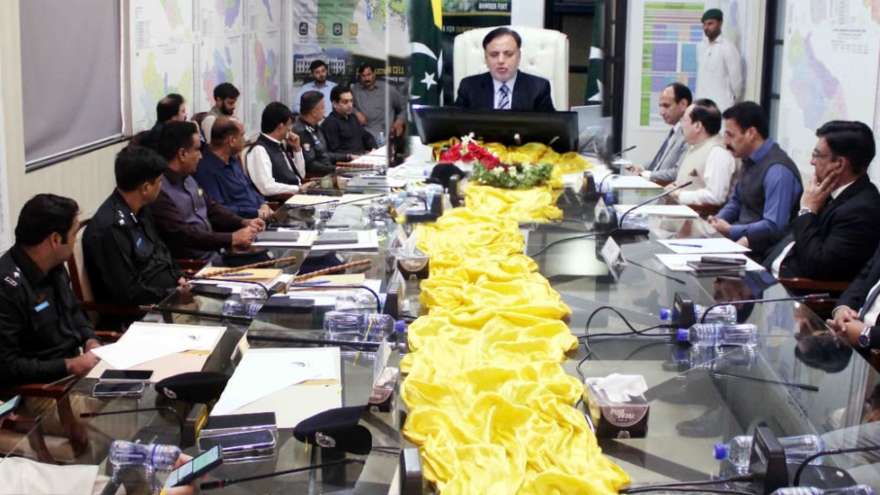
Chairing a high-level meeting in Mirpur to review election preparations, the Chief Election Commissioner expressed satisfaction with the administrative and security arrangements. He stressed that the judiciary, civil administration and security institutions must work in close coordination to maintain public confidence throughout the electoral process.
He also instructed officials that no negligence would be tolerated regarding the security of polling stations and directed authorities to respond swiftly and effectively to rumours related to the elections.
Responding to concerns over the phased conduct of the elections, Justice Mughal dismissed suggestions that results from one division could influence voting decisions in another. He said the people of Azad Kashmir possess strong political awareness and would exercise their democratic right independently.
Security measures
Briefing the meeting, Mirpur Division Commissioner Raja Tahir Mumtaz Khan said election arrangements had been completed across all three districts of the division.
He said the division has a total of 1,400,437 registered voters, including 724,811 men and 675,626 women.
A total of 2,316 polling stations have been established, of which 1,241 have been classified as highly sensitive, 724 as sensitive and 351 as normal.
The commissioner added that 288 candidates are contesting elections across 13 constituencies in Mirpur Division, with LA-3 Mirpur City recording the highest number of contestants at 34. Election monitoring will be carried out through 13 zones and 205 sectors, while polling staff, transport and other logistical arrangements have also been completed.
DIG Police Kamran Ali told the meeting that 18,560 security personnel, including police, civil armed forces and the Pakistan Army, will be deployed across Mirpur Division to ensure peaceful polling.
The deployment includes 5,536 personnel in Mirpur district, 4,504 in Bhimber and 8,520 in Kotli.
He said a three-tier security plan has been put in place, with the police forming the first layer, civil armed forces the second and the Pakistan Army the third. As part of the plan, 2,100 Army personnel will also be deployed to help ensure the polling process remains secure, orderly and peaceful.